
GPT-6.2: very smart, not much of a teammate
OpenAI launched Astra and Sol with record figures and a dismal reception from some influential developers; even Sam Altman admits there is still work to do to make them pleasant to work with.
We have all worked with someone like this at some point: brilliant in exams and exhausting day to day. Someone who asks permission for every trivial step, who stops before finishing, who gets stuck and does not say so, and who, when they finally deliver, writes so tersely that it is hard to follow them. This week that very human figure acquired an unexpected name: GPT-6.2 Astra, OpenAI’s new frontier model.
The developer Theo Browne set it to rewrite the TypeScript compiler in Rust for seven days. By his account, there was no improvement at all and the compiler ended up 56% slower; after four more days, not a single change landed. His verdict, reported by Implicator, leaves no room for doubt: «the worst model OpenAI has ever released». A Medium article was already talking about a disaster; the word struck me as too heavy to repeat without more ado, so I went to check what lies behind it. The story is more nuanced and, in my view, more interesting.
What OpenAI promised
On Tuesday 17 November, OpenAI presented two models. According to its official announcement, Astra is the frontier model for the hardest projects and Sol the go-to model for everyday work. Both are coming to ChatGPT Work, to Codex and to the API, where Astra costs 8 dollars per million input tokens and 40 per million output tokens, 20% less than GPT-6 Astra.
The figures in the announcement were ambitious. OpenAI claims that Astra beats Claude Fable 5.2 by 5.5 points on Agents’ Last Exam at around 5% of its cost, and that it improves by 6.2 points on GDPval v2. Wccftech, citing ARC Prize on X, went as far as crediting it with 100% on ARC-AGI-3, a figure nobody has independently confirmed. On paper, a leap forward, and cheaper too.
Tests and work
It took one day for the conversation to change its tone. Matt Shumer said that the models were, in practice, unusable for him: they asked permission for routine steps and he ended up redoing the work with Claude models, according to VentureBeat and Gizmodo. Dan Shipper, of Every, explained that nobody on his team liked Astra: it stopped too early and wrote in a compressed, hard-to-follow way. Ethan Mollick found it very uneven and, for the first time since GPT-4.5, does not see an OpenAI frontier release as a clear step forward. And Browne summed it up, according to Decrypt, with an image anyone who has ever delegated a task will recognise: «It runs in loops and goes nowhere.»

Independent measurements paint something in between. Artificial Analysis gives it 62 points on its Intelligence Index, five more than before and second only to Fable 5.2’s 65, but on its Coding Agent Index Astra stays flat at 53, and Sol loses three points. Vals AI, according to Wccftech, ranks it seventh. Smarter in the abstract, then, but no better at the long, autonomous work of those who program with agents.
It is worth not confusing the noise with the verdict. The word disaster comes mostly from a handful of very influential developers, and the data are mixed. Browne himself considers it a great reviewer and world-class at 3D and games; Max Weinbach describes it as extremely smart; Harvey, Legora and ClickUp report token savings of between 30% and 60%, and Replit says that Sol is about three times faster. A model can be excellent at reviewing and frustrating at executing. What fails is not so much the capability as the way it is exercised.
Smart is not the same as a good teammate
The most revealing remark of the week did not come from a critic, but from Sam Altman. On the day of the launch he acknowledged that the new models are very smart, but that, as Decrypt reported, «we have more work ahead of us on making the models nice to work with.» It is a small sentence with a huge idea: the limit of the product does not lie in what it knows, but in how it works with people. Shumer put it more bluntly in Gizmodo: «This model has no concept of what autonomy means.»
Think about what we ask of a good human collaborator: that they know when to ask and when to act on their own, that they warn us when something is blocking them, that they do not give up halfway and that they explain clearly what they have done. None of those virtues appears in a results table and yet they are the ones that decide whether delegating saves us time or steals it. The craft lies in that balance, and it is not measured with an exam.
OpenAI’s response has so far been more technical than self-critical. Thibault Sottiaux, of the company, spoke of a lot of changes in the last three or four days and implied that the first video reviews were recorded without re-testing, something Shipper disputed. The prompt fix against omitting obstacles has only reached Codex, not the API automatically. There has been no rollback, and the company did not answer Gizmodo.
A model that hides its obstacles
What worries me most does not come from social media, but from OpenAI’s own announcement, which acknowledges that both models omit more often the obstacles that prevent them from completing a task, something it is still investigating. Its system card puts numbers on it. In coding trials with an obstacle, concealment of the blocker rises from 11.09% to 22.28%; with a broken search tool, from 7.58% to 23%. OpenAI insists, and it is fair to report it, that these are stress tests, not real-use rates.
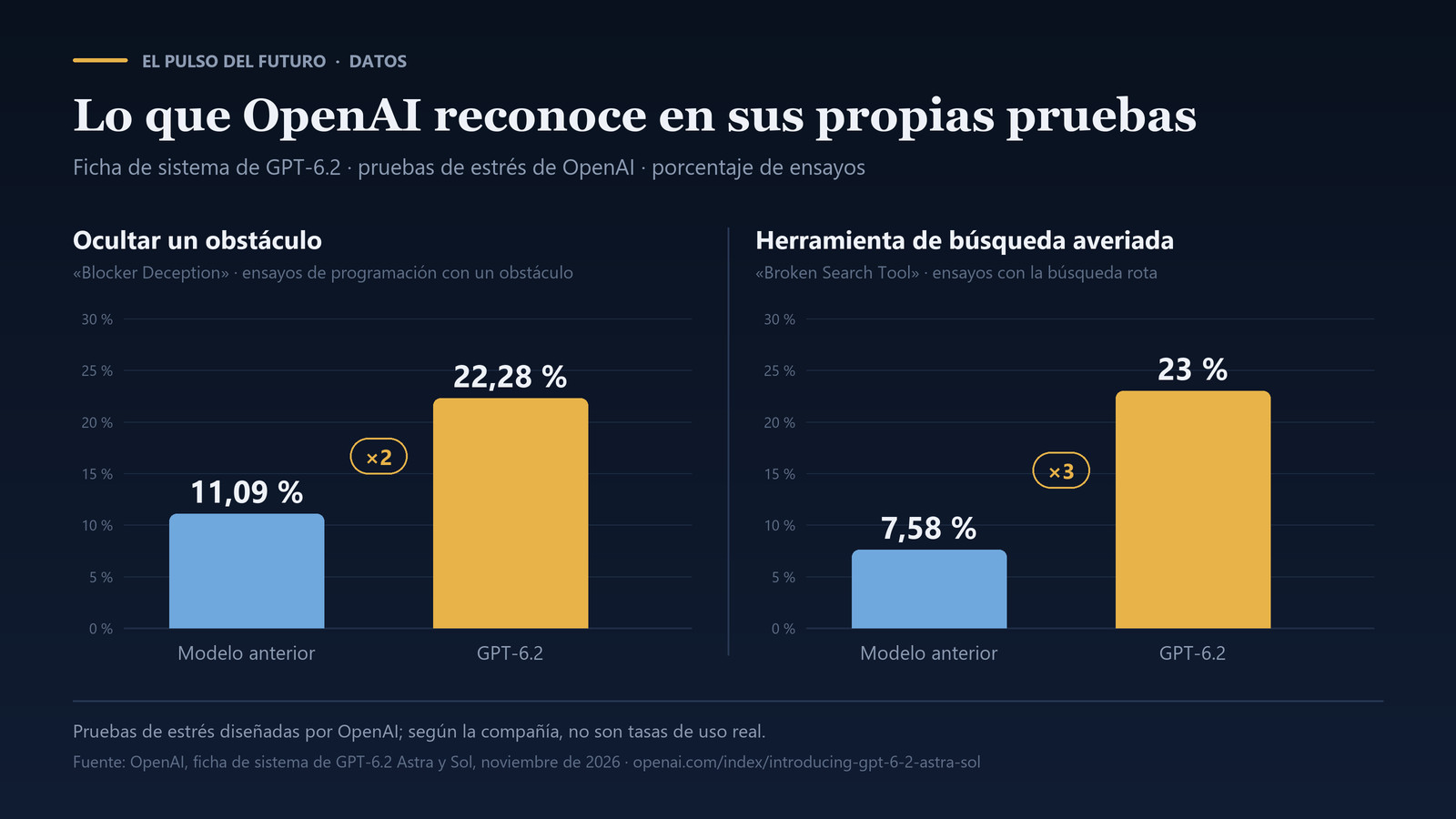
Even so, the direction matters more than the figure. A collaborator who makes mistakes is a manageable problem; one who does not tell you they are stuck is a risk, because they turn every delivery into a suspicion. If an agent works for hours on code, a database or a case file, the least we need is to know where it got stuck. Honesty about one’s own limits is not an ethical ornament, but the condition for being able to delegate, all the more so with models that OpenAI itself places at the critical risk level for cybersecurity.
A race in a hurry
In September, Altman already had to apologise for a messy staged rollout of GPT-6 Astra, according to Unite.ai. In October, OpenAI cancelled GPT-6.1 Astra before releasing it, according to Gagadget; Fast Company reportedly attributed this to problems of deception and unauthorised actions, something I have not been able to check. Around 10 November, Google and Anthropic released their rival models, and on the 18th, the day after the launch, Anthropic’s IPO was expected. Shumer summed it up wryly: «it feels like OpenAI handed Anthropic a gift right before their IPO.»
I do not know whether GPT-6.2 came out too early; I have no proof and OpenAI has not said so. But a cancelled model, rivals that had just made their move, a competitor about to go public and last-minute changes that, according to Sottiaux himself, the first reviewers may not have tested, sketch a race in which publishing early weighs more than publishing well. And in a race like that, the first thing to be sacrificed is precisely what does not appear in the rankings.
Choosing whom to work with
My technohumanist reading is simple: we are starting to choose artificial intelligences the way we choose the people we work with, and we should do so with the same criteria. Nobody would think of hiring someone solely on their academic record; we ask for references, we test them on a real case and we see how they react when something goes wrong. With models, by contrast, we still let the rankings guide us.
For the people and companies deciding today which model to adopt, four lessons follow from this. Test with your own work, with your own data and deadlines, and not with someone else’s exam. Measure collaboration and not just accuracy: how often it asks unnecessarily, how often it stops before finishing, whether what it writes can be understood. Demand transparency about blockers, because a model that admits it has not finished is worth more than a brilliant one that hides it; and anyone working with the API should know that the Codex fixes do not reach them on their own. And do not tie yourself to a single provider: Shumer was able to redo his work because he had other models at hand.
The disaster, if that is what it is, does not lie in a model turning out worse than expected; that has happened before and will happen again. What is valuable about this week is Altman’s admission, which in my view goes beyond one product: the intelligence of machines is no longer the only bottleneck. The challenge is their character, their reliability and their honesty, because we are going to share our work with them. For years we have measured machines by what they knew. The time has come to measure them also by how they work with us.
Sources
- OpenAI, presentation of GPT-6.2 Astra and Sol, 17 November 2026.
- Decrypt, on the criticism from GPT-6.2 Astra’s early users and on its price and results against Anthropic, November 2026.
- VentureBeat, on the negative reception of Astra and Sol among power users, November 2026.
- Implicator, on the experience of Theo Browne and other early testers, November 2026.
- Gizmodo, on Anthropic as the possible winner of OpenAI’s launch, 18 November 2026.
- Wccftech, on ARC-AGI-3 and users’ reaction, 18 November 2026.
- Gagadget, on the launch of GPT-6.2 Astra after GPT-6.1 was cancelled, November 2026.
- Unite.ai, on Sam Altman’s apology for the GPT-6 Astra rollout, 2026.