
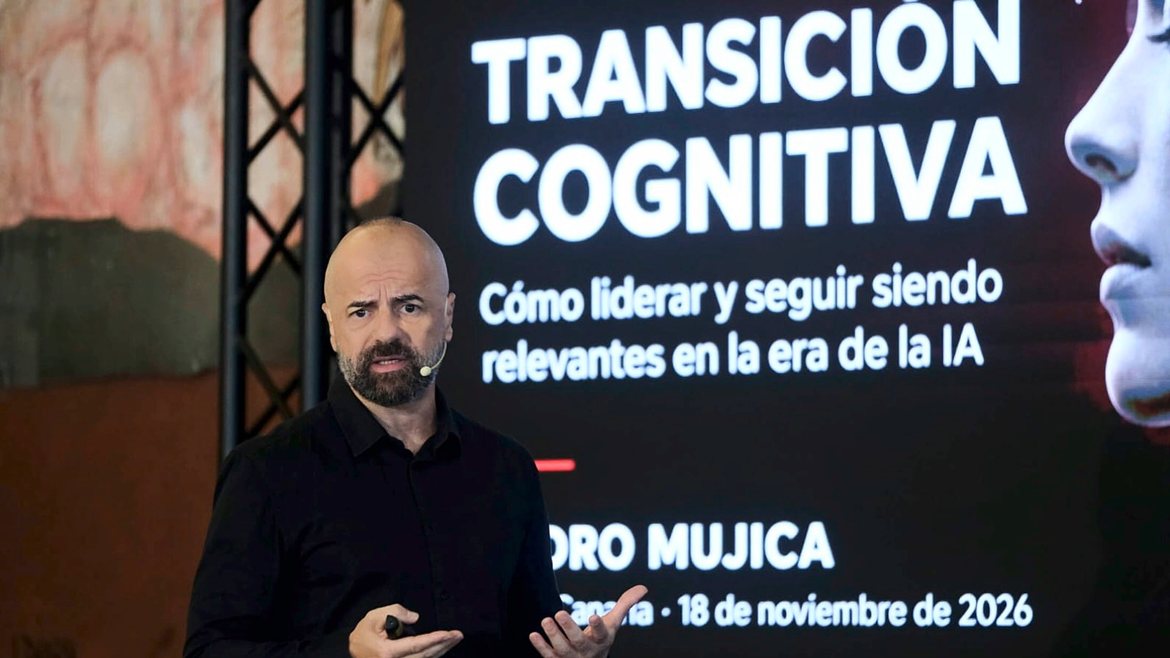
Pedro Mujica at Foro Santander: Cognitive Transition — speed is artificial, judgement is human
On 18 November I spoke about the cognitive transition to Canary Islands business leaders at the Foro Santander «Visión empresarial: Estrategia y Futuro». La Provincia summed it up in an idea I endorse; here I tell what a newspaper page had no room for.
On Monday 16 November, on the set of Cierre de Wall Street on Negocios TV, I was asked three questions I have been hearing everywhere for months: whether AI takes our jobs or makes us more productive, which jobs change first and what someone should learn today. Two days later I had half an hour to answer them before a room full of business leaders in Las Palmas de Gran Canaria. I put them on the screen just as they were, and my short answer is still the one I gave on television: AI does not replace people; it replaces people who stop learning.
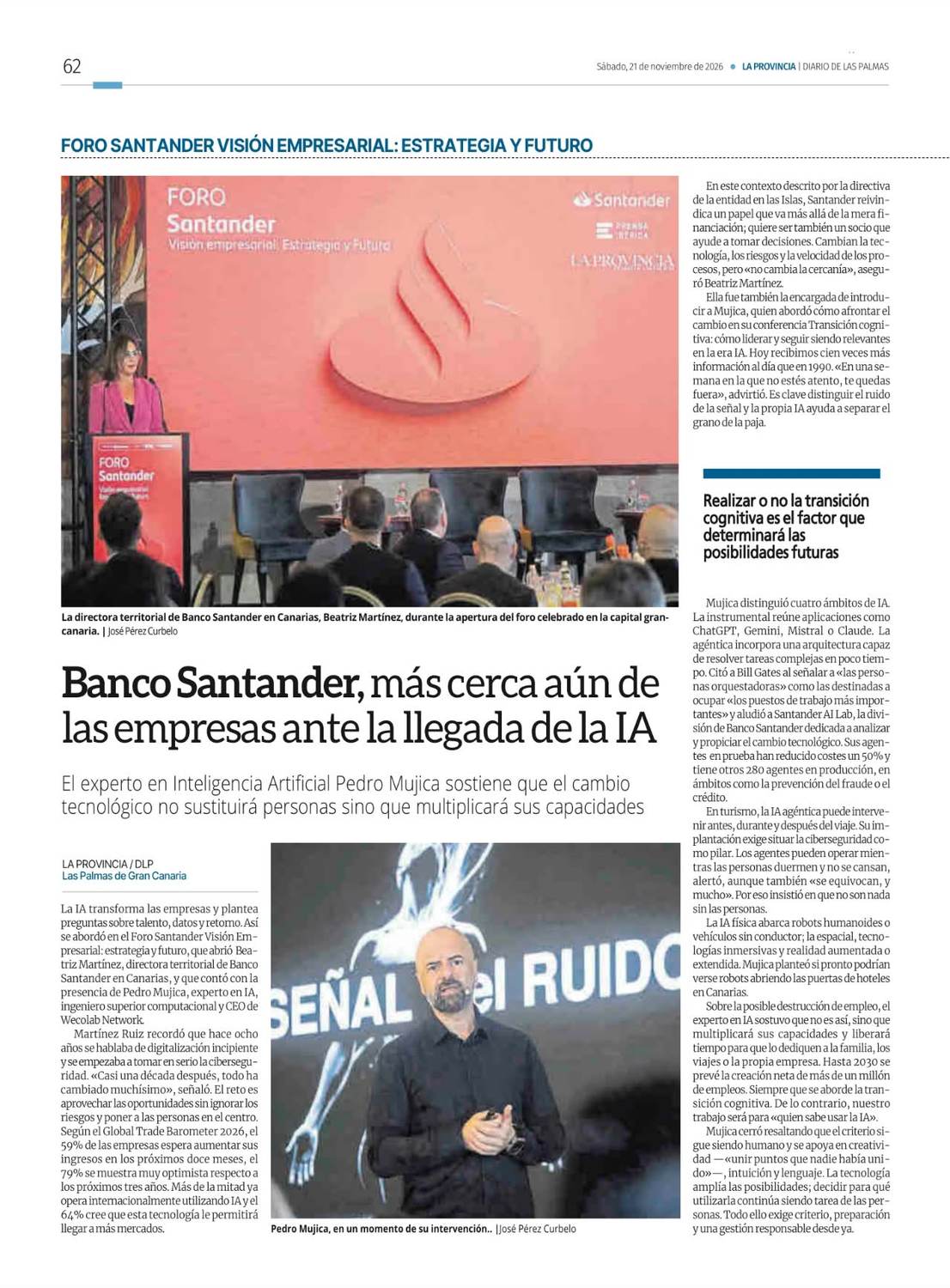
On Saturday 21, La Provincia published its report on the forum with a standfirst I am glad to read in someone else’s words: technological change «will not replace people but will multiply their capabilities». I thank the paper, and José Pérez Curbelo for his photographs, for the care with which they told it. Here are the most important parts of the report and what lay behind each of them.
A forum for deciding
The Foro Santander «Visión empresarial: Estrategia y Futuro» was organised by Banco Santander, Prensa Ibérica and La Provincia, and opened by Beatriz Martínez, Banco Santander’s regional director in the Canary Islands. She recalled that eight years ago people spoke of an incipient digitalisation and were only beginning to take cybersecurity seriously, and that since then everything has changed enormously. She also made the bank’s ambition clear: to be more than financing, a partner that helps make decisions, because technology, risks and speed change, but closeness does not.
The room was not homogeneous: there were companies that have not yet started with AI, others taking their first steps and others that already have it up and running. I suggested to all of them that they leave knowing where they stand and which path to follow. To set the scene, two figures from Spain’s National Statistics Institute (INE): 30.3% of Canary Islands companies with ten or more employees already use AI, compared with 17.0% a year ago, and the islands received 15.7 million international tourists in 2025. The Canaries are already in, and they live by moving people and things.
The signal and the noise
I began with the problem we all share. La Provincia reported one of the figures I gave, that today we receive a hundred times more information a day than in 1990, and the warning that went with it: «In a week when you are not paying attention, you are left out». The week of the forum was a good example: Anthropic had announced its stock market listing on the Nasdaq, Jensen Huang had resigned as chief executive of Nvidia, the Nasdaq had fallen 2.5% on Monday 16 and, that same day, even the chair of the Federal Reserve was talking about superintelligence. Not everything that makes a sound matters. Noise is not necessarily false; it is that, on its own, it does not tell us what to do on Monday.
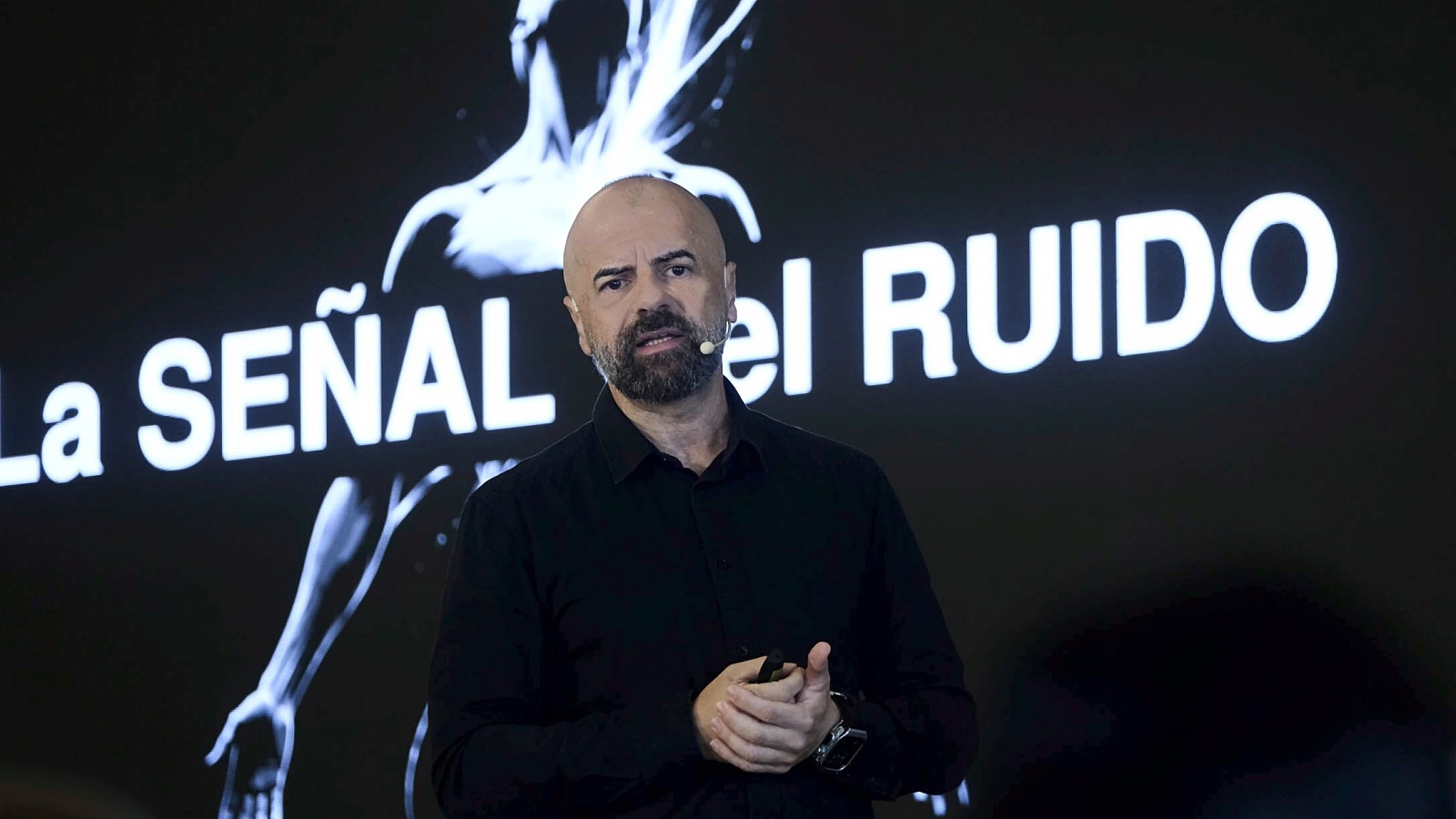
The signal, by contrast, has usually been broadcasting for some time. The signal of this conversation has a date: in 2014 Nick Bostrom published Superintelligence with Oxford, which reached Spanish readers in 2016 through Teell. It is the book that anticipated it, more than a decade before the debate reached the front pages. Telling the signal from the noise has become a management skill, and the paradox is that AI itself, well used, helps separate the wheat from the chaff. The question is not how much information we receive, but with what judgement we filter it.
The four forms of AI
To bring order to the noise I proposed a simple map: AI today takes four forms. Instrumental AI is the one we all already use, models such as ChatGPT, Gemini, Claude or Mistral, which improve and get cheaper every few weeks. Agentic AI no longer answers but acts: it chains steps, uses tools and solves complex tasks in little time. Physical AI is the one with a body, from humanoid robots to autonomous driving; Waymo has announced its first passengers in Madrid for 2027. And spatial AI enters our surroundings through extended reality, with display glasses already on sale in Europe, though not yet in Spain.
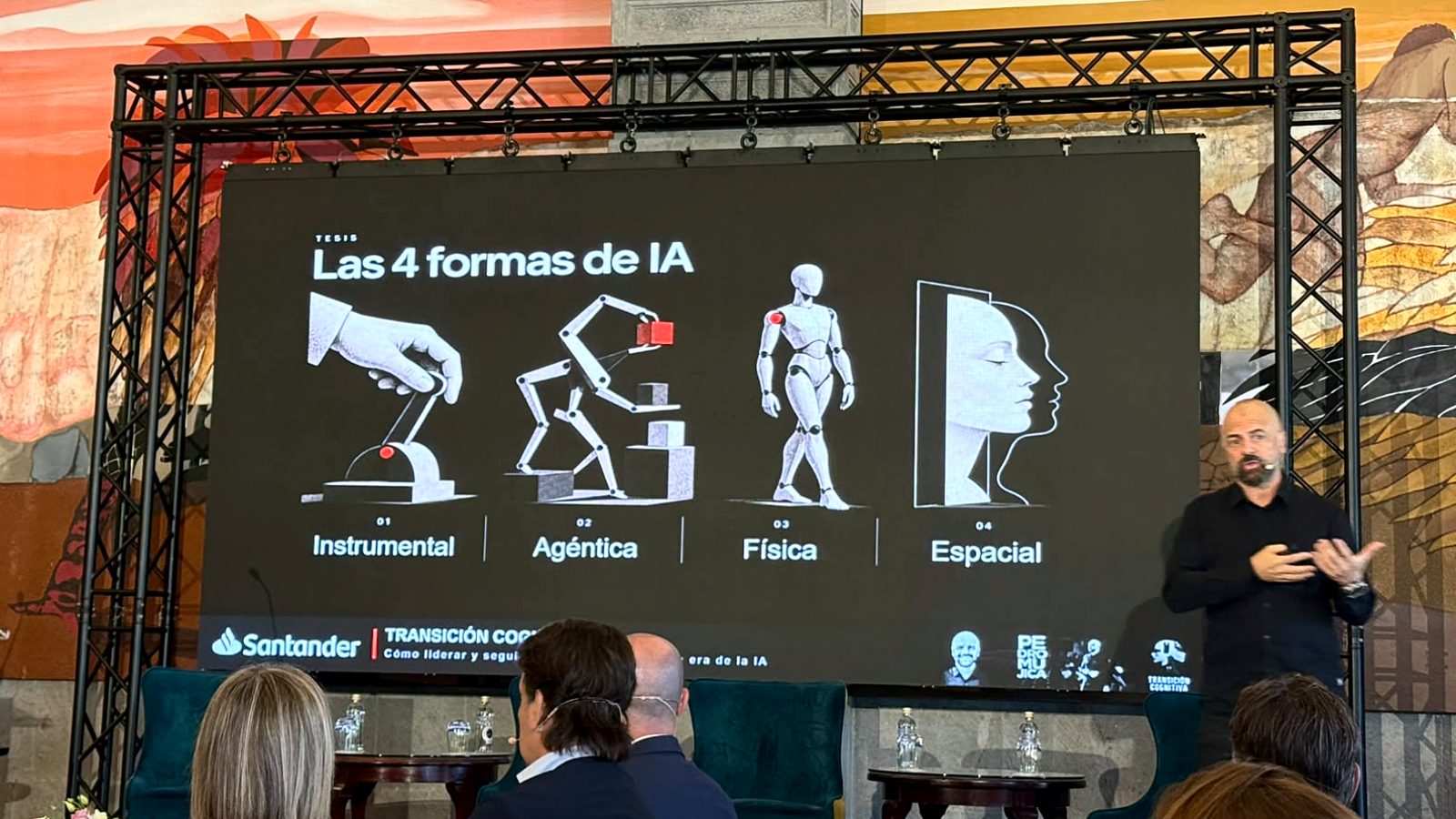
The interesting part is to bring that map down to islands that live from tourism. AI can step in before, during and after the trip: before, to stroll around the destination, try it and choose; during, to guide, translate and warn; after, to relive, share and come back. Physical AI left the room with two questions that are no longer science fiction: who will open the hotel door for us a few years from now, and what will happen to hire cars, transfers and buses when autonomous driving reaches the Canaries. The companies that ask themselves these questions today will be better prepared than those that discover them in the press.
It works while you sleep, and it gets things wrong
The form that is changing office work the most is agentic AI. An AI agent works while you sleep: it does not tire, it does not wait and it works in parallel; you decide when to look. The host bank is a good example: according to its own data, in trials of AI customer service the cost per conversation falls from 5 euros to 3 cents, and it already has more than 280 agents in production in credit, fraud and know-your-customer checks.
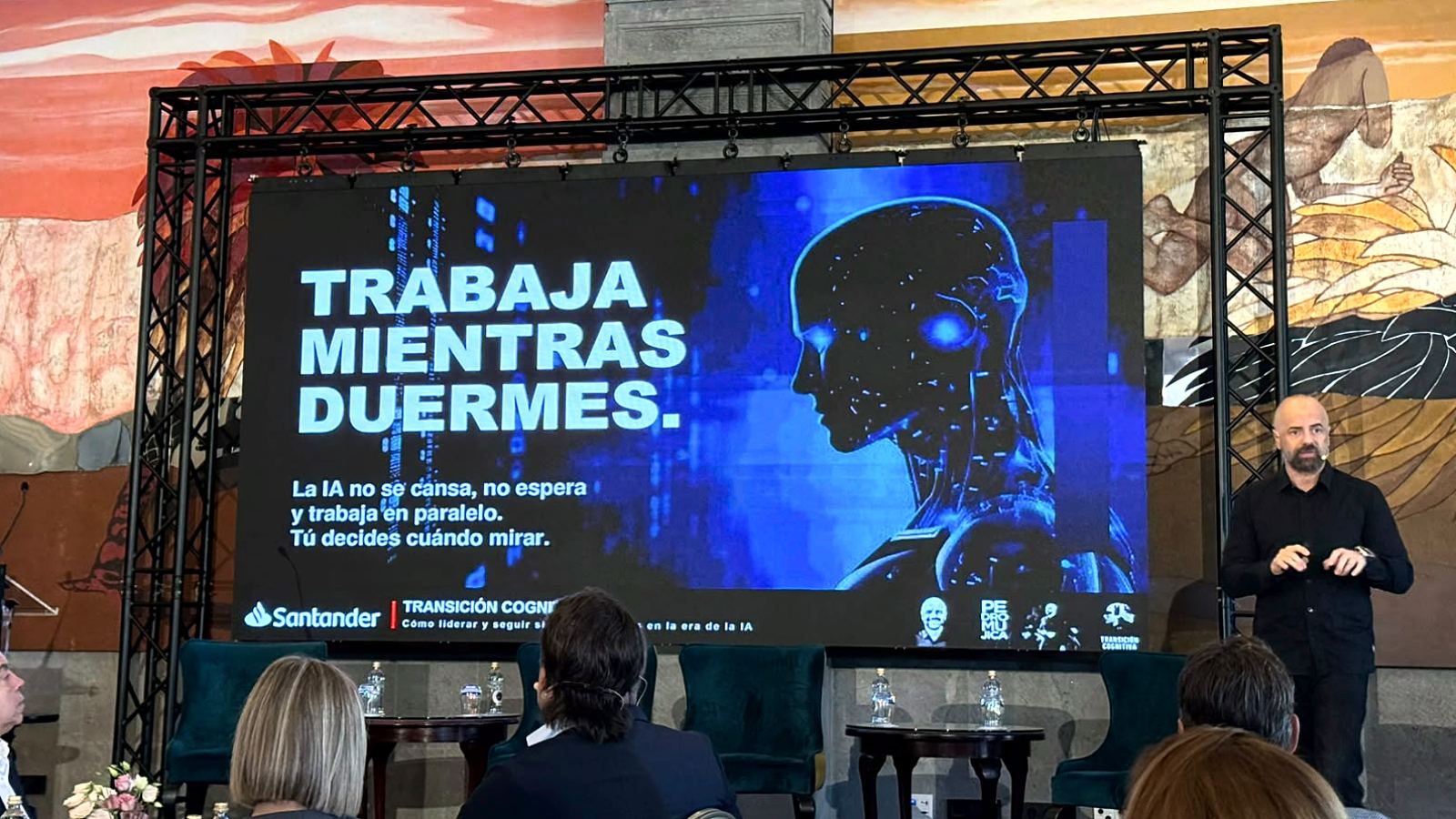
But watch out: they get things wrong, and a lot. With total confidence, without warning and plausibly, which is the most dangerous part. I told the story of one of the Big Four consulting firms, which delivered a report to a government with a court citation and references that had been invented, and had to pay back part of its fee. That is why cybersecurity has to be a pillar and not an add-on, and why I insisted that agents are nothing without people. Our role is a different one: orchestrator, not operator. Knowing what to ask for, knowing what to discard. The new skill is judgement, and that is why I put Bill Gates on the screen next to an idea that defines the decade: the AI orchestrator as the most important job of the next ten years.
Work will belong to those who know how to use AI
The employment question is the one that worries people most, and I did not dodge it. I do not believe AI is going to replace people, but rather multiply their capabilities and free up time for family, travel or the business itself. The data point that way: Gartner forecasts that up to 2030 10.6 million jobs will be created and 8.9 million destroyed, a positive balance of 1.7 million. But it is a forecast, and it comes with a condition. If we do not make the cognitive transition, as La Provincia reported, our work will go to «whoever knows how to use AI».
Therein lies one of the big decisions facing companies: juniorisation or seniorisation. Cutting back the learning of younger staff because a machine does their tasks looks like efficiency today, but it empties tomorrow’s talent pipeline. Investing in judgement raises the level of the whole workforce, because people reach expert judgement sooner. Every task AI does for your people is an opportunity to teach them to judge, and the time it frees up is not a gap to fill with more tasks but more time to be human: to listen better, understand better and help more.
Cognitive transition: what cannot be delegated
Everything leads to the central idea of the talk, which gives my book its title. How we know and how we decide is changing, because part of thinking already happens outside us. That cognitive transition is crossed with judgement or suffered without it, and making it or not will determine the future possibilities of every person and every company. Speed is artificial; judgement is human, and that is the DNA that has to remain in every company.
That judgement rests on three capabilities in which AI has not yet caught up with us. Creativity, which consists of connecting dots no one had connected before. The intuition born of experience, because AI is superb with language and speed but does not yet reach that practical knowledge. And language, which has become the tool. Before bringing AI into any process I proposed six questions: what problem are we solving, from what baseline are we going to measure it, who supervises it, what is plan B, who is accountable if it goes wrong and, most important of all, what are we not going to automate.
I ended with one path for each starting point. For those who have not started yet: a real problem, twenty minutes. For those who are starting: measure first and choose your first agent. For those already up and running: orchestrate and decide what not to automate. For everyone, an uncomfortable question: what am I already delegating without having decided to?
The golden age of cheap AI
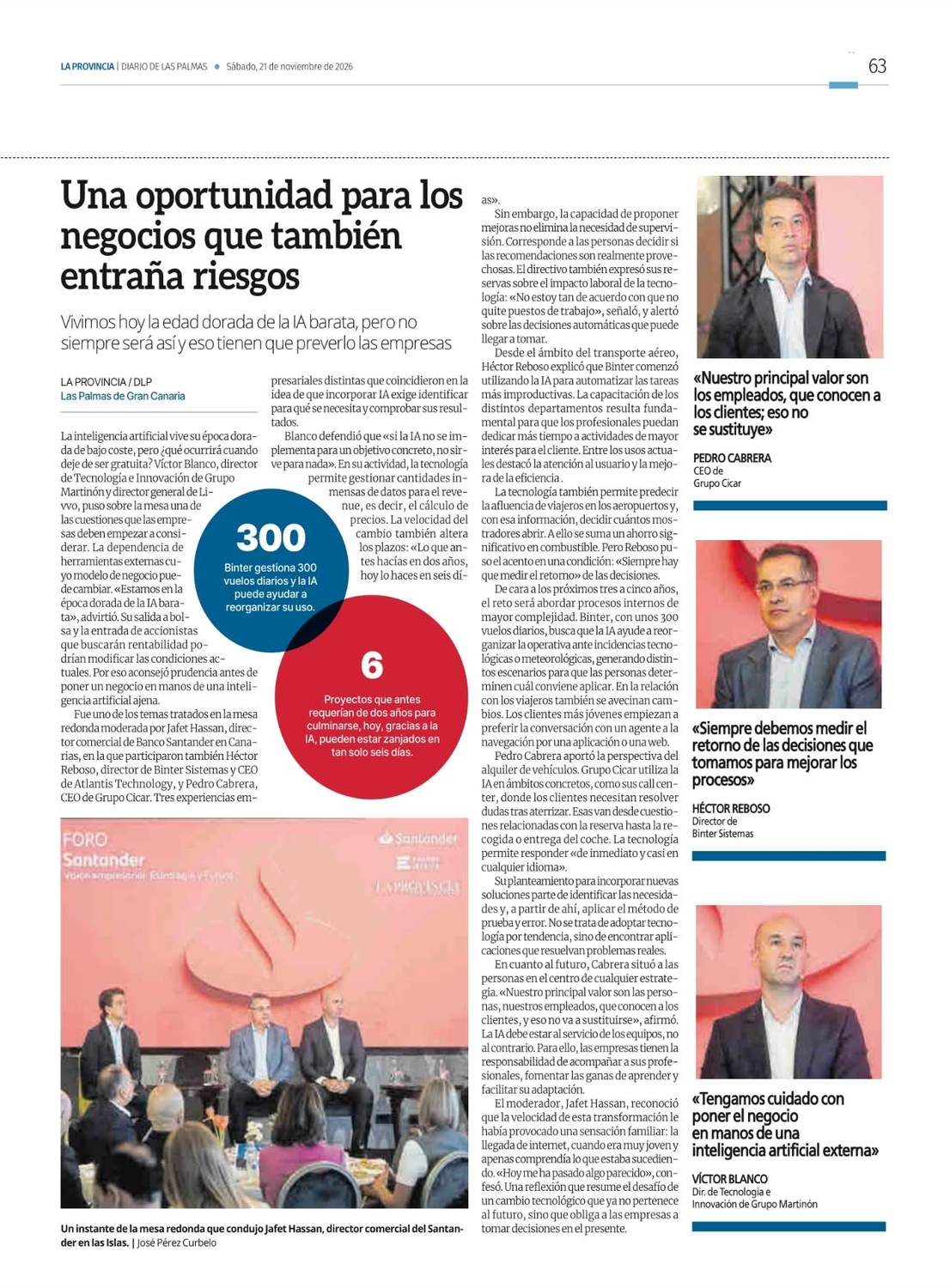
Then came the round table, moderated by Jafet Hassan, Banco Santander’s commercial director in the Canary Islands. Víctor Blanco, director of Technology and Innovation at Grupo Martinón and general manager of Livvo, warned that we are living through the golden age of cheap AI and that depending on external tools whose business model may change is a risk to be anticipated; he also voiced his reservations about employment, a counterpoint I appreciate. Héctor Reboso, director of Binter Sistemas and CEO of Atlantis Technology, explained how Binter, with some 300 flights a day, wants AI to help reorganise operations when incidents occur by generating scenarios for people to decide on, and called for always measuring the return. Pedro Cabrera, CEO of Grupo Cicar, explained that its call centre answers immediately and in almost any language, and recalled that its main asset is the employees who know the customers.
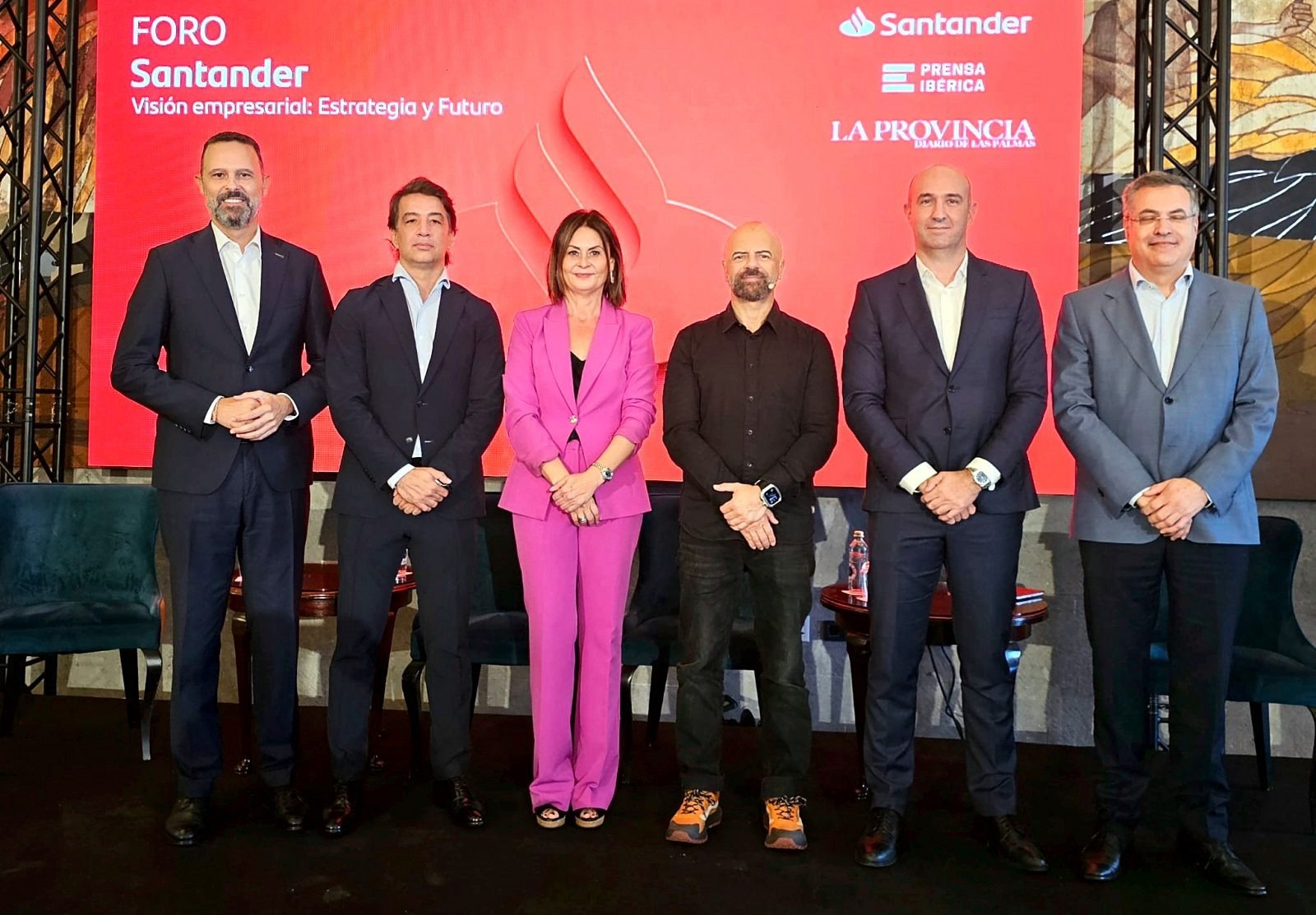
What the three have in common is the method: start from a real need, test, measure and never lose sight of people. Jafet Hassan closed with a confession I share: the speed of this transformation reminded him of the arrival of the internet, when he was very young and barely understood what was happening.
We are the future
I closed with a sentence that lies at the heart of technohumanism: AI is not the end of our possibilities, but the beginning of others. Technology widens what we can do; deciding what we use it for is still up to us. That demands judgement, preparation and responsible management, and it demands starting now, not once the wave has passed.
If this conversation interests you, I develop it at greater length in my book Transición Cognitiva (Cognitive Transition), the first volume of the Trilogy of Change. And if your company or your forum would like to bring this reflection to its people, here is my speaker dossier. My thanks to Banco Santander, Prensa Ibérica and La Provincia for the forum, to Beatriz Martínez and Jafet Hassan for their trust, and to everyone who was in the room. We are the future.
Sources
- La Provincia, «Banco Santander, más cerca aún de las empresas ante la llegada de la IA» (Banco Santander, even closer to businesses as AI arrives), 21 November 2026; in the print edition, pages 62 and 63, alongside the report on the round table, «Una oportunidad para los negocios que también entraña riesgos» (An opportunity for business that also carries risks).
- Pedro Mujica, «Transición cognitiva: cómo liderar y seguir siendo relevantes en la era de la IA» (Cognitive transition: how to lead and stay relevant in the age of AI), talk at the Foro Santander «Visión empresarial: Estrategia y Futuro», Gran Canaria, 18 November 2026. The figures on the slides come from INE (ETICCE, 22 October 2026; Frontur, 3 February 2026), Gartner (employment forecast, 10 November 2026), santander.com (19 October and 22 June 2026), AP via CTV News (7 October 2025), Anthropic (10 November 2026), Nvidia’s Form 8-K filed with the SEC (12 November 2026), Korea Times and Bloomberg Línea (17 November 2026), the Federal Reserve (16 November 2026), Waymo (20 October 2026) and Meta (23 September 2026).
- Nick Bostrom, Superintelligence: Paths, Dangers, Strategies, Oxford University Press, 2014; in Spanish, Superinteligencia, Teell, 2016.
- Negocios TV, Cierre de Wall Street, 16 November 2026.
- Pedro Mujica, Transición Cognitiva, Trilogy of Change, vol. I.