
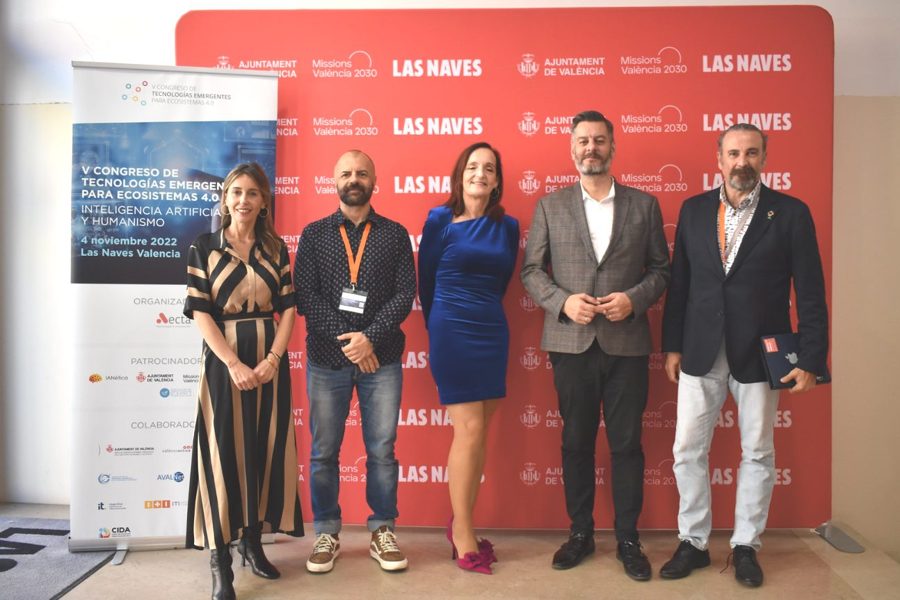
The opening talk at Las Naves placed human empowerment at the centre of a discussion that also covered security, auditing and employment.
Efficiency explains how much a system can do. It does not, by itself, explain what happens to the people working within it. That distinction was central to “Technohumanism and human empowerment: foundations of the fifth industrial revolution”, my opening talk at Emergentes 2022.
The event took place on 4 November at Las Naves in València. AECTA’s announcement confirms the date and places my contribution alongside Ignacio Villoch’s in a programme about AI and humanism. Infrastructure security, AI auditing and business practice were part of the same agenda. Preserving that setting matters: the discussion brought values into economic decisions rather than treating them as a separate subject.
Empowerment for whom?
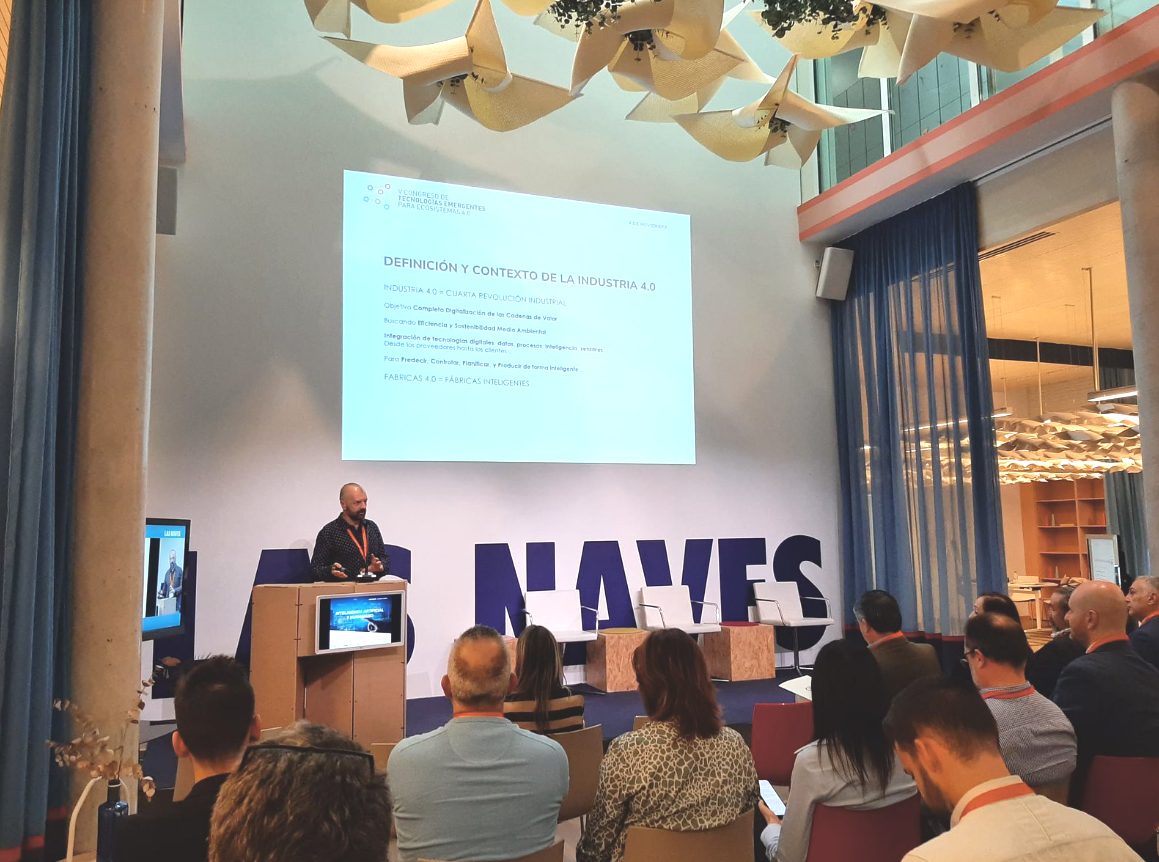
In the recording, my presentation questions automation and the worker’s place within it. Collaboration can describe very different relationships: a machine helping a person, a person temporarily compensating for a machine’s limitation, or complementary roles deliberately designed to endure.
Calling a process collaborative does not settle the distinction. We need to examine who can learn, intervene and change their position within it. That is the question I want to recover, without presenting every example from 2022 as a current technical claim or every prediction as an outcome that has already occurred.
Industry with greater human agency
My reading of the fifth industrial revolution is about more than adding a new label to a connected factory. It asks why the factory is connected and how benefits, risks and decision-making are distributed. Training, safety and participation by people who understand the work all have practical consequences for the answer.
The European Commission’s Industry 5.0 document provides useful context: a human-centric, sustainable and resilient industry. It does not establish the results of any particular company. It does help us ask a modernisation proposal to explain more than its promise of productivity.
Ethics needs a place in decisions
I recover the photographs and recording because they let us revisit a public conversation that preceded the widespread adoption of conversational assistants. Concern about human consequences did not begin with the arrival of a new consumer product.
Before automating a task, an organisation can begin with a modest question: what capability does the person working with this system gain? If our answer only describes how much work is removed, an important part of the design remains unfinished. A revolution worthy of the name should also expand what people can understand, propose and decide.
Sources and archive records
- Pedro Mujica · Archive: speaker, Archive entry.
- AECTA · Foro Tecnologías Emergentes, Pedro Mújica e Ignacio Villoch abrirán las ponencias inaugurales de Emergentes 2022. Organiser’s announcement: 4 November 2022.
- Comisión Europea, Industry 5.0: Towards a sustainable, human-centric and resilient European industry. Contextual framework published in 2021.
Related reading from the present archive: Technohumanist Manifesto 2025.