
Pedro Mujica on «Cierre de Wall Street» (Negocios TV): AI, more productivity or more unemployment?
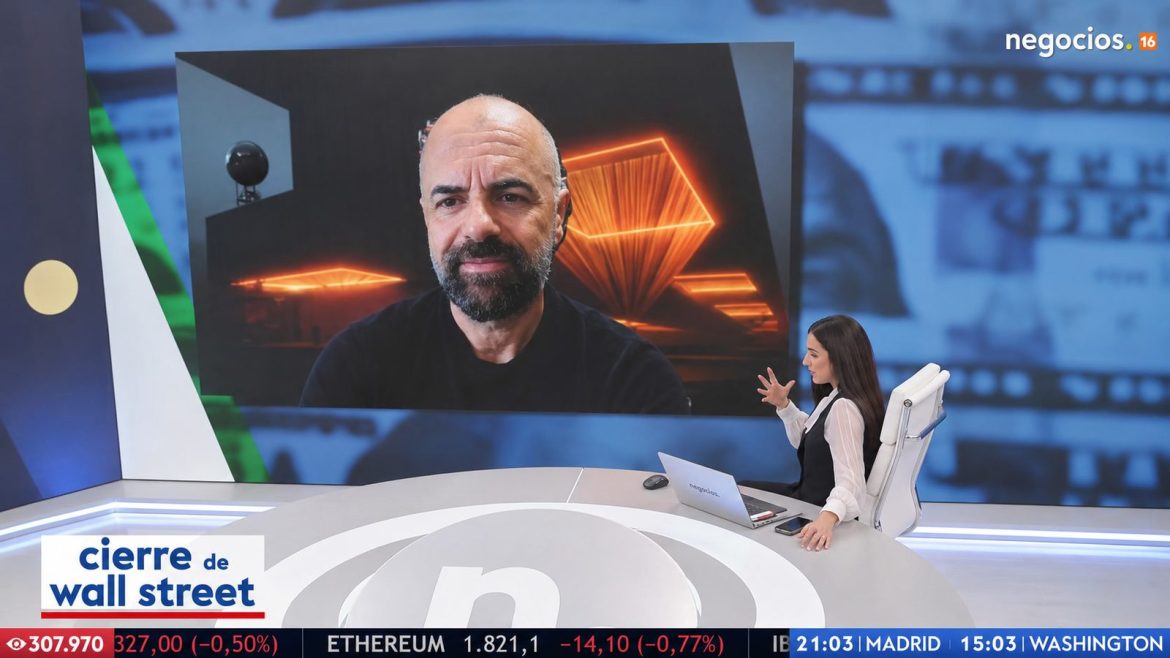
On Monday 16 November I was on «Cierre de Wall Street», the Negocios TV programme, the business channel of Movistar Plus+, talking about artificial intelligence and jobs. Here is the full interview, with the video, my answers word for word and the sources of the news items behind it.
On Monday 16 November 2026 I was invited to «Cierre de Wall Street», the market-close programme of Negocios TV, the business channel of Movistar Plus+. On screen I was introduced as «Pedro Mujica · Author of Superhumanos» and the topic was «Artificial intelligence: more productivity or more unemployment?». It was eight minutes live, on a split screen between the cover of my book Superhumanos, published by Editorial LID, and my camera. The interview was in Spanish; the English below is my translation.
I had been sent a script with five questions. Live, one question changed from the script and another was added at the end, so what follows are the questions as they were asked on air and my answers as I gave them, with the punctuation tidied and little else. I include everything, the programme’s lines too, because the conversation makes more sense whole.
What was being discussed that day
The programme started from three news items of the moment:
- Warsh and superintelligence. That same Monday, Federal Reserve Chair Kevin Warsh opened the Fed’s conference on productivity and jobs in San Francisco. He described «super intelligence» as «an entirely new force in economic life and society» and set out three illustrative scenarios, which he stressed are not forecasts: broadly shared productivity gains; an expansion that «could bring substantial labor market disruption as some jobs are displaced, rather than complemented, by technology», with unemployment above levels consistent with full employment; and a disappointment with an economic slowdown and a more notable rise in unemployment. (Federal Reserve.)
- Daly and productivity. According to the programme’s script, San Francisco Fed President Mary Daly had said the previous Friday that there is little evidence that AI improves productivity. It is the line she already took in February: «most macro-studies of productivity growth find limited evidence of a significant AI effect». (San Francisco Fed.)
- US job postings. Also according to the script, US job postings as measured by Indeed had fallen 46.7% since 2022. The figure is the programme’s; Indeed’s postings series are published by its Hiring Lab.
The video
The interview, word for word
This is the full transcript of the video, taken from its Spanish captions and translated into English. I corrected proper names, capitals and punctuation and removed a few filler sounds («eh», «ehm»); where the audio cannot be understood I mark it «[inaudible]». The programme’s lines are in italics and mine in regular type; each question links to its minute in the video.
«… once again on artificial intelligence, in the three scenarios they are now weighing, above all, well, with the arrival of AI in employment. We are going to talk about it with Pedro Mujica, author of Superhumanos. Thank you very much, Pedro, for joining us.»
Pedro Mujica: «Thank you very much to you all, it is a pleasure to be here.»
Pedro, the pleasure is ours. We were also listening today to Kevin Warsh talk about those advances, that scenario with more unemployment from automation, with the arrival of artificial superintelligence, but I wanted to ask you:
What is a superhuman in the era of AI we are living in now?
Pedro Mujica: Well, the thesis of the book, although it talks about physical capabilities, in the end explains very well that a superhuman is neither a robot, nor a cyborg, nor a human with augmented powers. They are really a normal person who works with artificial intelligence at their side.
Since AI, artificial intelligence, provides speed, memory and calculation, but the one who provides judgement, ethics and purpose is always the person, and whoever knows how to use it well is, for me, a true superhuman. For example, a doctor who could review in minutes what used to take hours and spends that time saved treating the patient with greater empathy.
For me the summary would be: a superhuman is human plus artificial intelligence, but always with the human in charge, making the decisions and with the best possible judgement.

Is it really so, Pedro, that it is always under human supervision?
Pedro Mujica: I think not; in most cases, unfortunately, it is not done with the best judgement. Judgement has to be learned, it is something you have to train every day, devoting as much as you can, and keep developing it, because right now artificial intelligence follows the flow of the user’s requests too much, that is, it goes along with you, and you have to know how to filter each answer well and, in that process, keep gaining that judgement I am talking about, because only of super, let’s say, we would all be at the human level, using artificial intelligence, and continuing to rise through the levels takes considerable effort.

I also wanted to ask you, Pedro, about the current situation, right?
Which jobs are going to change first?
Because we were already seeing how big companies like Google, like Microsoft, like Amazon are, well, encouraging employees, right?, to retire earlier than planned and, above all, well, trying to replace them with artificial intelligence. Which are the jobs that would suffer first?
Pedro Mujica: I think it will be screen jobs and everyday repetitive processes; that is, for example, customer service, administration or basic accounting, all translation of course, writing or simple programming, even in my own guild, of course [inaudible] a lot and they are going to be part of this great transformation, this great cognitive transition, which is the title of my second book, by the way, which is already on sale on Amazon, I take the opportunity.
The paradox is that automation reaches the office, in this fifth industrial revolution, before the factory, and the last jobs to change will be manual ones, those of human presence and contact. That is, for example, electricians or nurses or carers, since the population is ageing worldwide, so they will be the last to be affected; even white-collar workers are in quite a lot of danger.
And I would say that, before the job, the task changes and, for example, the lawyer does not disappear as such, but the lawyer who does not use artificial intelligence does; that is what I was saying earlier about judgement. We are all called to make the great cognitive transition and to train ourselves to develop the judgement the new era demands.
Pedro, artificial intelligence:
Do you think it will take our jobs or will it make us more productive, in any case?
Pedro Mujica: Both things at the same time, and it depends on us, as I have said. Job postings, for example in the United States, which are falling almost 47% since 2022, are a warning, but not everything is due to artificial intelligence. Interest rates and the end of the post-pandemic boom also weigh.
I would say that in the short term tasks disappear and entry-level positions slow down, for example juniors. The loss of juniors is becoming a problem, the know-how, the transfer of knowledge. And then in the medium term productivity arrives; that is, if companies train their people and redesign their processes, they will bring about this great change, the one that is needed. And it is not just about buying artificial intelligence licences, but about education and training.
That is, AI is not going to take your job, it is not going to take our jobs; someone who uses artificial intelligence better than you is going to take it, undoubtedly.
What should someone learn today so as not to be left behind in all this?
Pedro Mujica: Well, three things, and to be memorised. The first would be to use artificial intelligence every day in real work. That is how you gain judgement. For example, half an hour a day. You have to ask it, you have to compare the answers well. As I said before, AI tends to go along with us and many times to lie to us, unfortunately. And then, when that is detected with judgement, correct it. That would be the first: it must be used every day.
The second would be developing judgement. We are genuinely creative and we know how to connect the dots in a way very different from artificial intelligence. This is what defines the basis of judgement. That is, knowing how to ask, verify, use intuition and detect errors is fundamental. AI is going to make mistakes and many times it is going to lie to us with total confidence, and we are the ones who must correct it. That is why, in the chain of decisions using artificial intelligence, the human always has to be present, or even at the end when things are important. That is, judgement would be, the development of judgement, in this way that I explain.
And the third would be to value the human side of each one of us, such as communication, empathy, leadership itself and, above all, critical thinking. That is, we should never compete with the machine, we only have to learn to direct it well and always with judgement. This is the real strength of what a cognitive transition would be, as I define it in my second book, executed impeccably.
[inaudible], Pedro, that we have the need, right? Like schools starting to teach earlier about artificial intelligence, that we train ourselves more and more…
Is there no way back in all this?
Pedro Mujica: No, there is no way back. I do not think there is a way back, unless a catastrophe happens, which we hope it does not. And I think that, if it is steered well and focused well, above all in education, the new education, right?, the new education, and we are able to react to so much change, so accelerated, I think we can head towards a future that we all want.
Of course, there will always be handicaps, stumbles, two steps forward, one back, put in everyday terms, in what we are all weighing up, but I would remove anxieties; we have to embrace this new era and, above all, we have to learn, train ourselves, develop judgement, trust our own abilities, and the younger you learn all this, the better. Therefore, education must change and in schools it must be introduced with every safeguard. Careful, it is not a free-for-all. For example, regulating social media is now being done very well, and artificial intelligence has to be done in the same way, but there is no way back. The workers of the future have to know how to direct and use artificial intelligence well, there is no other way.
«There is no other way, indeed. Thank you very much for joining us, Pedro Mujica, author of Superhumanos. It has been a pleasure listening to you.»
Pedro Mujica: «Thank you very much to you all, a real pleasure.»
«Warm hug, Pedro.»
That is the end of my part; the video goes on for a few more seconds with the programme’s sign-off.
What I take from the interview
If I had to sum up eight minutes in one idea, it would be the one I repeated in several ways: judgement. A superhuman is a normal person with AI at their side and always with the human in charge; judgement is trained every day; and whoever takes our job will not be AI but someone who uses it better than we do. I develop it at more length in Superhumanos (Editorial LID) and the transition I describe is in Cognitive Transition, my second book, already on sale on Amazon in paperback and Kindle.
Thanks to Negocios TV for the invitation and the time. You can see the page for this appearance at Media Press and learn about my work as a speaker at Speaker.
Sources
- Negocios TV (Movistar Plus+), «Cierre de Wall Street», interview with Pedro Mujica: video on YouTube, 16 November 2026.
- Kevin Warsh, Chair of the Federal Reserve, «Opening Remarks», Productivity and Jobs Task Force Conference, San Francisco, 16 November 2026.
- Mary C. Daly, Federal Reserve Bank of San Francisco, «The AI Moment? Possibilities, Productivity, and Policy», 17 February 2026. Her remark of the Friday before the interview was in the programme’s script.
- Indeed Hiring Lab, «US Labor Market Snapshot — June 2026» (23 July 2026) and job postings tracker. The 46.7% figure was in the programme’s script.
- Pedro Mujica, Superhumanos, Editorial LID.
- Pedro Mujica, Cognitive Transition, Trilogy of Change, vol. I.
- Page for the appearance on Pedro Mujica’s website: Media Press; Speaker page.