

Archive recovered in November 2026. The header date refers to the original appearance; this entry provides context and is not a verbatim transcript.
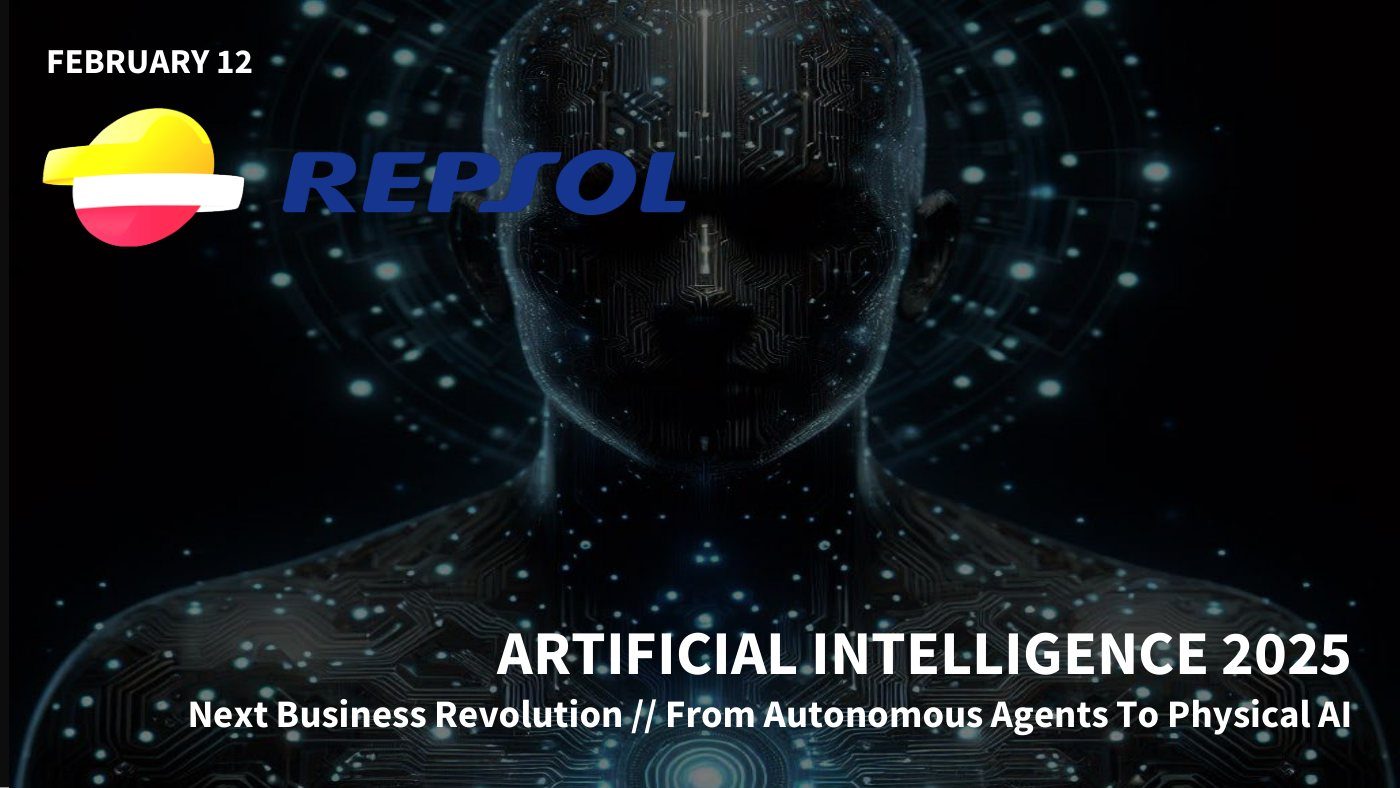
On 12 February 2025 I delivered an English-language online conference for Repsol Trading, titled “Artificial Intelligence 2025: Next Business Revolution”. The original material moves from AI history to assisted productivity, autonomous agents and physical AI.
The format matters: this was an online session, not an appearance at a refinery. The industrial cover image comes from the presentation materials and supplies context. It does not identify a particular facility or document a visit there.
A shared vocabulary for a business conversation
The presentation began with a historical overview to distinguish approaches and position generative tools. Organisational use requires decision-makers to discuss capabilities and limits without becoming specialists in every technology.
Work examples included reports, summaries, drafts and knowledge management. These tasks support questions that can be checked: what quality is required, which information is available and what review is needed before a result is used?
Copilot and responsibility for the result
The Microsoft 365 Copilot section considered documents, meetings and presentations. It is recovered as part of the February 2025 syllabus, without assuming every function was enabled for every attendee or treating it as current licensing and setup guidance.
A tool may propose a summary, but someone must verify that it preserves the relevant facts. Faster completion alone does not determine whether an output is suitable for sharing or further use.
From agents to action in the world
The second part opened a discussion about systems that chain actions and the relationship between models, simulation and the physical world. NVIDIA Cosmos identifies that field. A technology appearing in a talk is not evidence of its deployment by Repsol Trading.

Governance belongs inside the project
The closing material addressed bias, transparency, privacy and accountability. I retain that structure without repeating market forecasts or expectations about general intelligence as established facts.
The technohumanist contribution is to keep human decisions visible: what is delegated, what is checked and who can stop or correct an action. NIST’s risk-management framework offers a public reference for continuing the discussion. That connects the exploration of new capabilities with practical decisions about their use.
Another appearance from my current archive: Pedro Mujica at Foro Santander: Cognitive Transition — speed is artificial, judgement is human.