
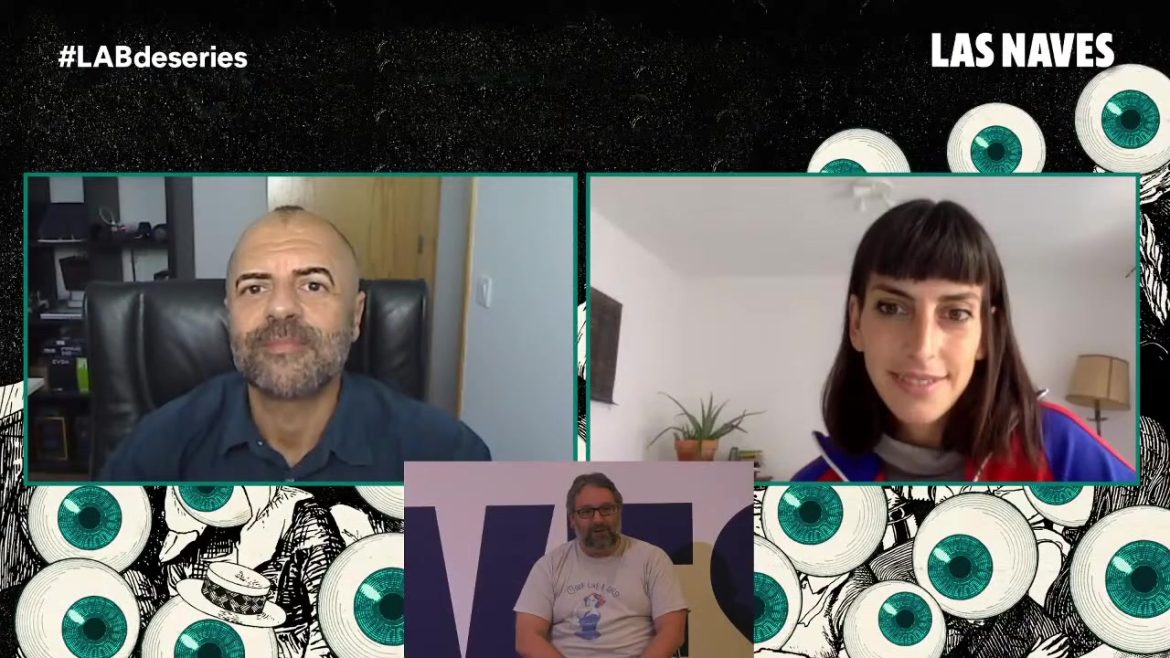
I joined Moon Ribas and Carlos Santana in a discussion moderated by Javier Palanca. From earthquakes felt through the body to Westworld: perception, identity and human judgement.
What happens when science fiction becomes a way of inhabiting the body rather than something confined to a screen? On 22 April 2021, I took part in a LABdeseries discussion hosted within Las Naves’ activities in València. The programme asked whether we were ready to live with robots. One participant had spent years investigating life with a sense she had not been born with.
I shared the discussion with cyborg artist and activist Moon Ribas and engineer and science communicator Carlos Santana, known for his Dot CSV channel. Javier Palanca, a lecturer and artificial intelligence researcher, moderated. Moon and I joined remotely: sharing a panel did not mean that everyone was physically in the auditorium. The complete recording contains this first discussion and a second about television and society after coronavirus.
Between fiction and lived experience
Westworld, Humans and Black Mirror create situations in which to examine what we expect from artificial intelligence. A convincing scene does not demonstrate consciousness, however, and a human-looking character does not explain how a real system works. Revisiting the discussion requires that distinction: fiction opens questions; technical answers need evidence.
The player starts around 20:40, at my contribution. Moon introduces her seismic sense around 35:36; from approximately 37:04 she explains the project, followed by its translation into dance. These are passages from a 2021 conversation, rather than a demonstration of every device’s current capabilities.
Moon Ribas: sensing the planet’s movement
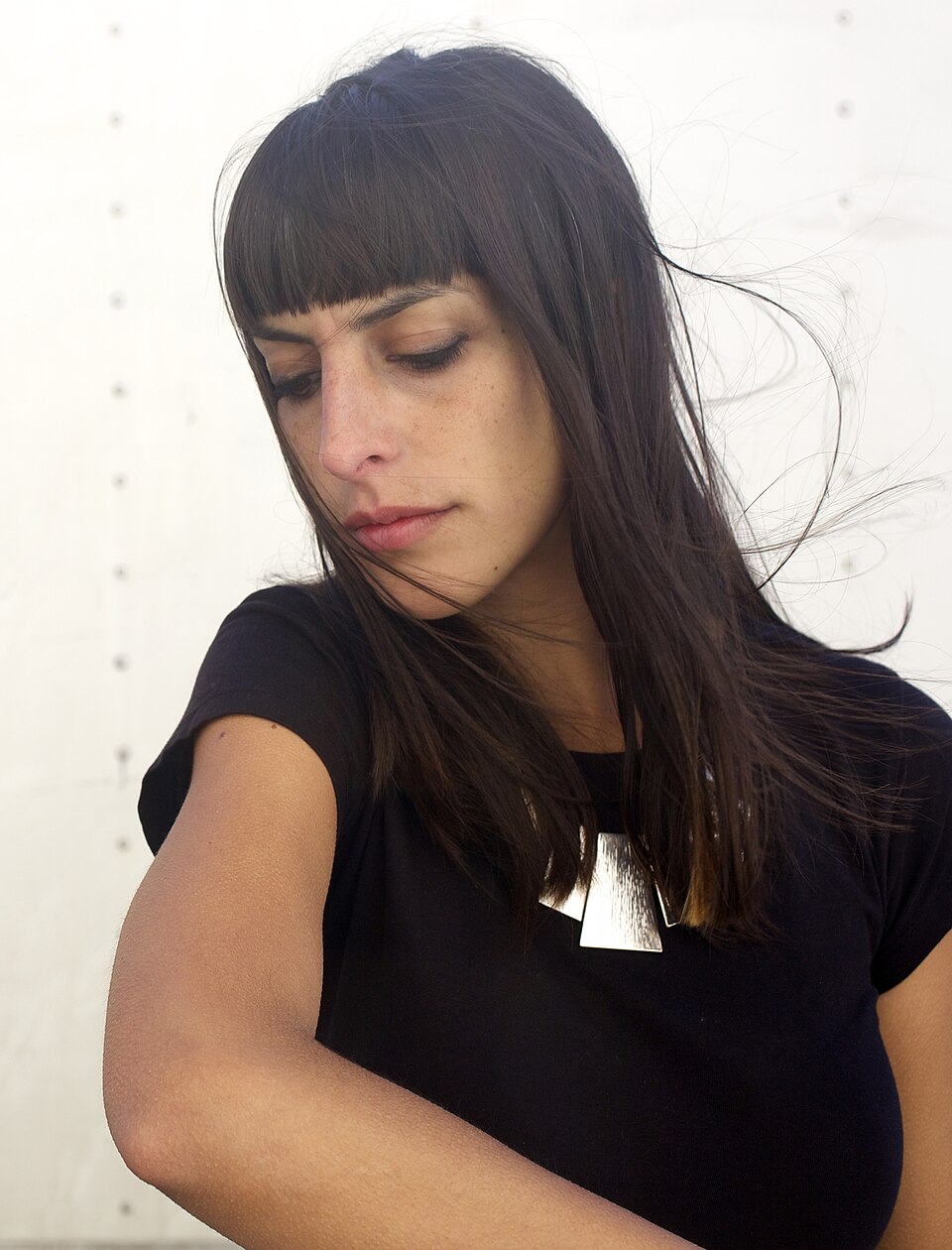
Moon Ribas is a choreographer and cyborg artist. Her biography describes implants she wore in her feet for almost seven years, receiving information about the Earth’s seismic activity through bodily vibrations. Known as the seismic sense, the project brought a stream of data into bodily perception.
In Waiting for Earthquakes, movement communicates that experience to an audience. The Earth’s activity determines when and how intensely to dance. The sensory experience accompanied her everyday life; performances gave that continuous perception a public, shared form.
During the 2021 panel, Moon said she had already removed the implants and described sensations that persisted afterwards. Her artistic account adds another dimension: the memory of perception and the relationship between body, surroundings and identity, even after the device no longer accompanies her.
Neil Harbisson: hearing colour
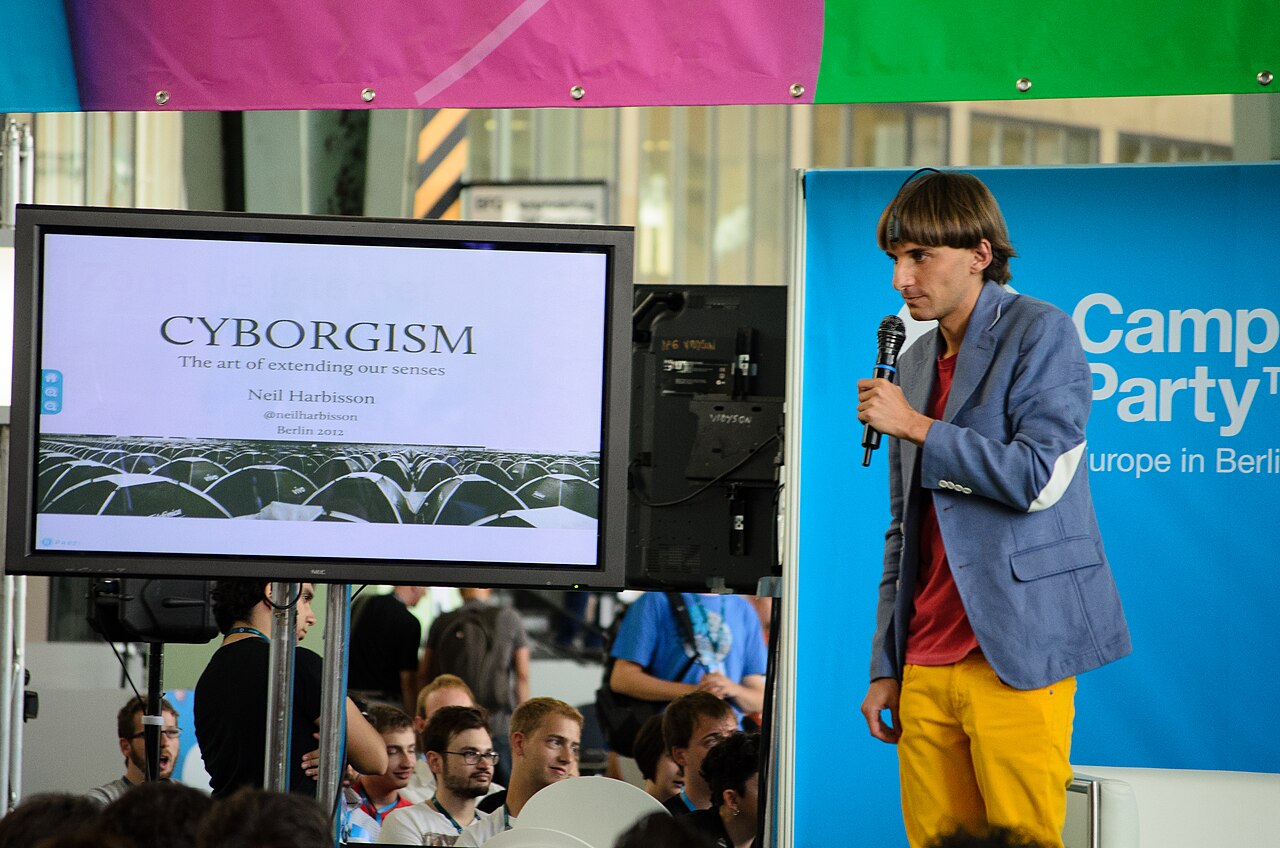
Neil Harbisson, an artist who co-founded the Cyborg Foundation with Moon in 2010, offers another example of sensory extension. His antenna translates colour information into sound vibrations. The CCCB documents this work, including exploration beyond the spectrum visible to humans. Hearing colours describes a sensory translation, rather than conventional colour vision.
Neil was not a speaker on this panel. His work provides context for Moon’s, which deserves recognition under her own name and through her own artistic career. Both invite us to think about technology through artistic practice: the question extends beyond which device to buy to what relationship we want to build with the world.
Cyborgisation and transhumanism are distinct ideas
I use cyborgisation to discuss integration between organism and technology, including the extension of capacities or senses. Transhumanism describes a broader philosophical horizon: transforming human conditions and capacities through science and technology. Humanity+’s Transhumanist Declaration advocates that possibility alongside autonomy, attention to risks and inclusive responsibility.
Not everyone with an implant adopts that philosophy, and not every cyborg experiment pursues immortality, superiority or escape from the body. Treating these practices simply as a race to become more powerful would obscure what matters in the examples above. Perceiving differently can serve an artistic purpose, express identity or seek a closer relationship with nature.
A technohumanist reading: extending without compelling
Looking back at this panel today, I see a productive connection with technohumanism: technology can create forms of expression and experience that deserve respect. Human judgement also protects the freedom to experiment with one’s body. Defending diversity should include forms of difference that feel unfamiliar.
The tension emerges when a possibility becomes a requirement. Being able to extend a sense should not mean having to do so to keep a job, receive care or belong to a group. Nor should it marginalise people who choose to live without the device. A society that recognises autonomy only when people agree to modify themselves imposes a new bodily norm.
Practical questions sit behind the fascination. Who controls the information received by a connected implant? What happens if its supplier disappears or changes the service? Can the person disconnect it, repair it or have it removed? Who can access those options? Autonomy needs maintenance, understanding and a way out; a promise of freedom without those conditions can create dependency.
These questions are my present editorial reading of the conversation, rather than statements I attribute to Moon, Neil or the other participants. They establish a difference of emphasis: transforming capabilities may be valuable, but a person’s value does not depend on the extent of their transformation. The technohumanism I defend asks us to assess technology through the lives and decisions it enables.
What television lets us rehearse
Television has power because it places these tensions in imaginable situations: stored memories, changing bodies, companies managing experience, or characters to whom we attribute an inner life. It lets us rehearse sympathy and fear. The danger comes when the force of a story is mistaken for evidence that its technology already exists or must develop in that particular way.
That panel brought together AI communication, cyborg art and a humanist perspective. Restoring its participants’ names gives the archive something a generic summary loses: different viewpoints that help us ask a better question. Beyond whether we can live with robots, what conditions do we want for living together as our relationship with technology changes?
Sources and archive records
- Pedro Mujica · Archive: press, Archive entry.
- València Innovation Capital / Las Naves, El poder de las series · Xarrades. Full session; Pedro’s introduction from 20:40. Automatic transcript consulted.
- Las Naves, Memoria anual 2021. Organiser’s record naming the four LABdeseries participants.
- Moon Ribas, Biografía y práctica artística. The artist’s account of her implants and seismic perception.
- CCCB, Neil Harbisson. Profile and documentation of colour perception practice.
- Humanity+, The Transhumanist Declaration. The movement’s own statement, distinguished from this article’s technohumanist reading.
Related reading from the present archive: HAL 9000 and our expectations of AI.