
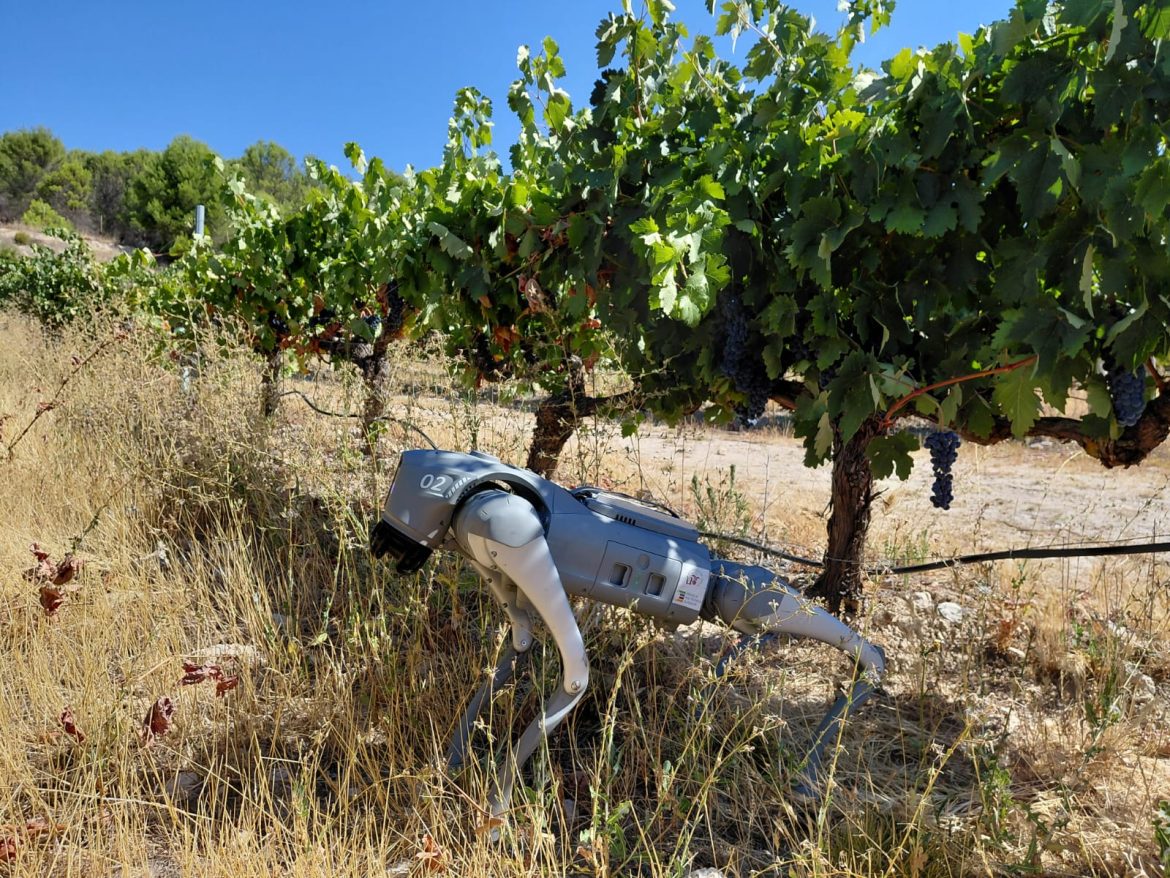
Gossip, the Spanish robot dog that walks the crops: what it is and what changes in the field
Spain’s La 2 showed Gossip on «Agrosfera», a robot dog that walks a crop to observe the state of plants and fruit. It is an experimental project of CTAEX, in Extremadura, which the press also calls AGRHOUND. What it is, who builds it, what it has shown and what it may change in the field.
On 23 November, the account of Spanish public television channel La 2 posted the original La 2 / Agrosfera reel on Instagram on Instagram with this text: «Gossip is a robot created to walk through a crop and observe the state of plants and fruit. On ‘Agrosfera’ they get to know this experimental project that is already being tested in Extremadura». The footage shows the robot walking past an olive tree; the text only says «a crop». I saw it and the question came by itself: is it a Spanish robot dog?
It is, in the sense that matters: it is developed by the Centro Tecnológico Agroalimentario de Extremadura (CTAEX) with partners that provide the test farms in Valladolid and Huelva. And it has three names. RTVE calls it «Gossip», Canal Sur spells it «Gosip» and most of the press knows it by the project’s name, AGRHOUND. «Agrosfera», the farming programme of La 2 on RTVE Play, devoted its 21 November broadcast to the novelties of Datagri, the agricultural innovation forum in Valladolid, with «drones, smart tractors, robot dogs» according to its synopsis; the video does not say which programme features Gossip, so I cannot be sure it is that one. Here is what is known about the robot, with sources.
Gossip, Gosip or AGRHOUND: one robot, three names
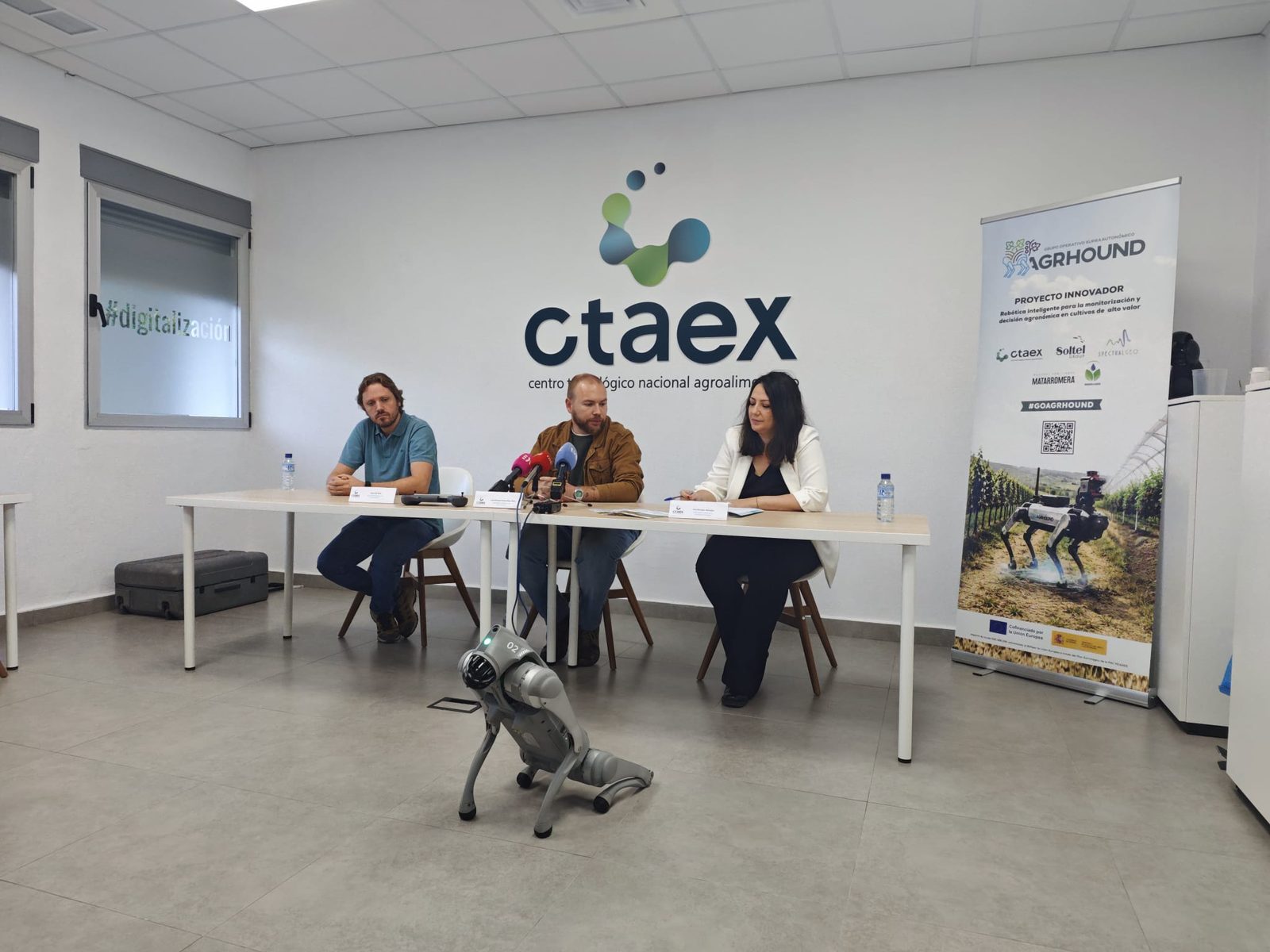
On 18 November, Canal Sur reported that an operational group is testing, on a farm in Gibraleón, Huelva, a robot dog it calls «Gosip», with cameras, sensors and artificial intelligence to supervise the fields. It quotes Luis Muñoz, head of R&D projects at the Centro Tecnológico Agroalimentario de Extremadura (CTAEX), and mentions a collaboration with the Escuela Politécnica de Sevilla.
The rest of the press calls it AGRHOUND. The person in charge, the organisations and the province match, and RTVE presents it as an experimental project being tested in Extremadura, so I treat it as the same robot. CTAEX, based in Badajoz, presented it on 14 October 2026 at its facilities in Villafranco del Guadiana, with a demonstration on its experimental farm.
- Who: a cross-regional operational group made up of CTAEX, Bodegas Familiares Matarromera, Social Berries 4.0, SpectralGeo and Soltel, with the collaboration of the Prodti Foundation, according to Mercacei.
- Where: a tempranillo vineyard in Ribera del Duero, with Matarromera, and blackberries under a macro-tunnel in Huelva, with Social Berries 4.0.
- When: it started in June 2026 and runs until early 2029. This year is for collecting data and getting the algorithms running; the 2027 and 2028 harvests will be used to test it in real conditions.
- How much: the operational group’s entry on the AKIS platform gives a budget of €594,129 and the 2023-2027 CAP as its main funding source; Vozpópuli cites €592,386.09, 80% co-financed by the European Union through the EAFRD. Both figures are around six hundred thousand euros.
- Which machine: none of the sources I read gives the make or the model, nor the weight, battery or range. I will not guess.
What it does and what it does not do yet
According to Xataka, the plan has three phases. First, autonomous navigation in open fields, macro-tunnels and greenhouses. Then, characterising the crop and generating real-time spectral maps that show how ripe the fruit is. Finally, deciding where to go and collecting samples with a robotic arm, with no human help. The results would reach the farmer in a simple app, with georeferenced maps.
Today, says Huelva24, the robot records data at close range from the plants and the algorithms estimate their vigour, physiological state and ripeness; they also want to calculate the yield forecast, that is, how much production to expect, in order to plan labour, harvesting and sales. Canal Sur adds that it has already moved autonomously through different agricultural settings and that the tool would be deployed in the field around 2029. Muñoz told Canal Sur, according to Huelva24, that it «has practically zero limitations when it comes to walking through the field».
A dose of caution is in order, and the media themselves supply it. Vinetur notes that the project is at the trial stage, that no data on productivity, time saved or accuracy has been published, and that the advantage of legs over wheels on uneven ground is a hypothesis to prove, not a guarantee. Muñoz puts it this way: the main challenge is to show that the robot is useful and profitable for the farmer, and simple enough to fit into daily work.
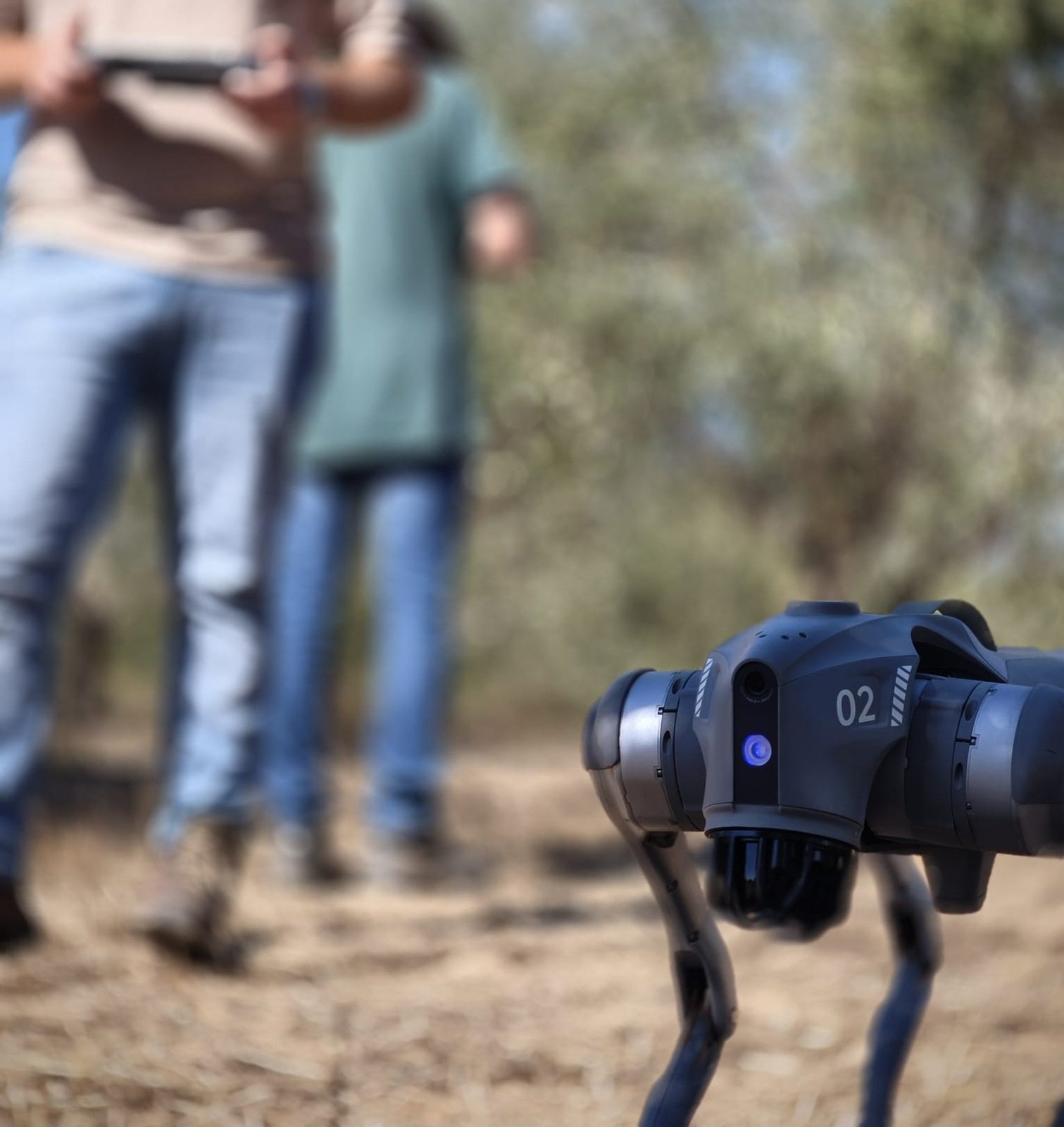
And the olive tree?
The olive grove does not appear in any of the notes on AGRHOUND. The closest thing I found is earlier and comes from abroad: in September 2024, the University of Córdoba announced tests with a Spot, the quadruped from Boston Dynamics, a US company. It is run by the research group on Remote Sensing Applied to Precision Agriculture, according to COPE Jaén, and is part of HIBA+, the agri-food digitalisation network between Spain and Portugal led by the Junta de Andalucía. Its job is not to harvest or prune: with LiDAR it builds three-dimensional maps of the terrain and, combined with multispectral and thermal imagery, supports decisions about the tree’s vigour and water status. I have not found published results of those tests.
The idea is not only Spanish. In Chile, the company Frutas AI has a four-legged «agronomist dog» that walks vineyard and orchard rows measuring plant by plant, according to Meteored, which also warns that it is not an all-terrain robot and does not replace the agronomist’s judgement.
In other words: the olive tree in the video is the landscape, not the job. Gossip observes high-value crops, and the olive grove enters this story as context and as an open question.
The olive grove: world leader, and short of hands
Why the olive tree matters is explained by the Spanish Ministry of Agriculture: Spain accounts for 39% of the world’s olive oil production and 67% of Europe’s. And the first forecast for the 2026/27 campaign, published on 1 October, points to 1,602,596 tonnes, 23% more than the last one, with Andalusia accounting for 79% of the total.
That harvest has to be picked, and that is where the tension lies. In October 2025, El Debate quoted Rafael Navas, secretary general of Asaja Córdoba: «There are no people to work in the fields, but the list of unemployed is long». It described day wages of around 70 euros and warned: «Either there is a drastic change or these difficulties in finding workers will get worse». That is the real context for any robot in the countryside: not a science-fiction fantasy, but a large sector that cannot find hands at the right moment.
But let us not confuse the problems. A robot dog that measures and takes samples does not pick olives. It solves another part of the work, looking and deciding, which today technicians and farmers do by walking the plots. Harvesting is still another conversation.
Technohumanism on the farm
One sentence from Luis Muñoz deserves to be quoted in full, according to Xataka: the aim is not to replace the people who work in the fields, but to cover more plots in less time and obtain information that is hard to collect today. It may sound like a textbook answer. To me it is the right formulation, as long as it is kept.
My thesis, the one I defend in Superhumanos, is that technology is worth it when it puts the human being in charge: the machine brings speed, memory and reach; judgement, ethics and purpose come from the person. A robot dog walking an olive grove or a vineyard is physical AI doing exactly that: legs, cameras and sensors where a person would need a whole morning. What changes work is not the machine but who decides what to do with what it sees. If the farmer uses the data to decide better when to harvest and whom to hire, that is technohumanism. If someone else uses it, from a distance, to dispense with the farmer, it is something else.
So I keep three questions for when there are results: who owns the farm’s data, how much the robot costs compared with the day wage it saves or complements, and what training the person operating it gets. Today there is no public answer to any of them, and it is worth saying plainly: so far there is a promising trial, not a result.
What I take away
Gossip is a genuinely Spanish robot dog, with a public budget of around six hundred thousand euros, real partners and a calendar running to 2029. What it does today is observe and collect data; what it promises, deciding where to go and taking samples, is not yet proven, and CTAEX itself acknowledges that the point is to show it is useful and profitable for the farmer. That is what I ask of this technology: that it be measured, that it be published and that it serve the people who work the land. I will follow the story and, when there are results, I will tell them here.
Sources
- CTAEX, official presentation of the AGRHOUND platform and photographs of the real equipment. Source of this article’s three photographs.
- RTVE La 2 (@la2_tve), Instagram video about Gossip, 23 November 2026; «Agrosfera» on RTVE Play and the 21 November 2026 broadcast (in Spanish).
- Canal Sur, «PROYECTO: Gosip, el perro robot con inteligencia artificial que cuida de los cultivos agrícolas en Huelva», 18 November 2026 (in Spanish).
- Xataka (Antonio Vallejo), «Un perro-robot guiado por IA ya está patrullando los viñedos de Extremadura», 20 October 2026 (in Spanish).
- Huelva24 (H. Corpa), «Prueban en Huelva un perro robot para controlar los cultivos», 3 November 2026 (in Spanish).
- Mercacei, «El CTAEX presenta su ‘perro robot’…», 19 October 2026 (in Spanish).
- Vinetur, «CTAEX prueba un robot de cuatro patas para inspeccionar viñedos y fincas de frutos rojos», 27 October 2026 (in Spanish).
- Vozpópuli, robot dog developed in Extremadura, 23 October 2026 (in Spanish).
- AKIS platform, AGRHOUND Operational Group entry (budget, partners, 2026-2029 period).
- Europa Press, «El ‘perro robot’ de Extremadura: presentan un robot cuadrúpedo», video on YouTube (in Spanish).
- Agronews Castilla y León, «La Universidad de Córdoba lidera la innovación en la agricultura con un robot cuadrúpedo», 23 September 2024; COPE Jaén, «Un ‘perro robot’ para vigilar tu cosecha en el olivar», 23 September 2024 (both in Spanish).
- Meteored, «Este robot agricultor con forma de perro…», 20 February 2026 (Frutas AI, Chile; in Spanish).
- Spanish Ministry of Agriculture, Fisheries and Food: first olive oil forecast 2026/27 (1 October 2026) and World Olive Tree Day press release (20 November 2025), both in Spanish.
- El Debate (Manuel Yaben), «La odisea de explotar un olivar…», 18 October 2025 (in Spanish).
- Pedro Mujica, Superhumanos, Editorial LID.