
Archive recovered in November 2026. The header date refers to the historical record; this is a contemporary editorial reconstruction.
In July 2008, Coca-Cola brought Campus Party Valencia a project connecting its happing community with participants’ meaningful places and experiences. Happing Map, the “Map of Happiness”, let people mark a special place on Google Maps and share it with others. WECOLAB designed and developed that service.
Coca-Cola’s press release of 24 July 2008 places the introduction at the twelfth Campus Party, held in Valencia from 28 July to 3 August. I preserve the release alongside videos, screenshots, instructions and later development material. This is the event where I participated with Coca-Cola to present Happing Map.
A map of places that matter
Happing Map invited people to share why a place mattered: a memory, an activity, an encounter or a location worth recommending. A geographical coordinate became the starting point for a conversation.
The original manual distinguishes setting your own location from marking a special place. A marker could include a title, a comment and a category, with visibility restricted to friends or opened to the community. Sport, favourite places, games and Internet were the categories recorded in that documentation.
Connecting an online community and a physical gathering
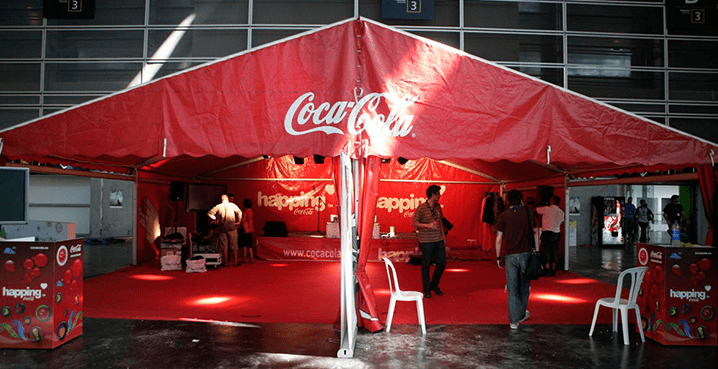
Campus Party brought together people sharing a physical space, digital culture and a willingness to experiment. The release announced that more than a hundred young participants would help start the map. That number describes the launch plan rather than an audited usage result.
Coca-Cola sponsored Campus Crea and offered photography, video and music activities. Happing Map had its own role within that setting: connecting personal experiences and locations through a participatory service.
WECOLAB’s contribution within a wider project
The release identifies Genetsis as the company designing and developing the happing community with Coca-Cola’s team. It credits WECOLAB with Happing Map’s design and development, while La Chula Productions coordinated the creative workshop and the event’s audiovisual production. The map was our contribution to a wider project.
WECOLAB’s portfolio preserves a public Coca-Cola Happing Map project page and visual material. In recovering this history, I distinguish that work from the entire campaign and from the performances shown in the event recordings.
Continuing after the launch
The archive contains screenshots and development proposals from 2009, documenting the service beyond its introduction in Valencia. The screenshot included here is explicitly dated August 2009.
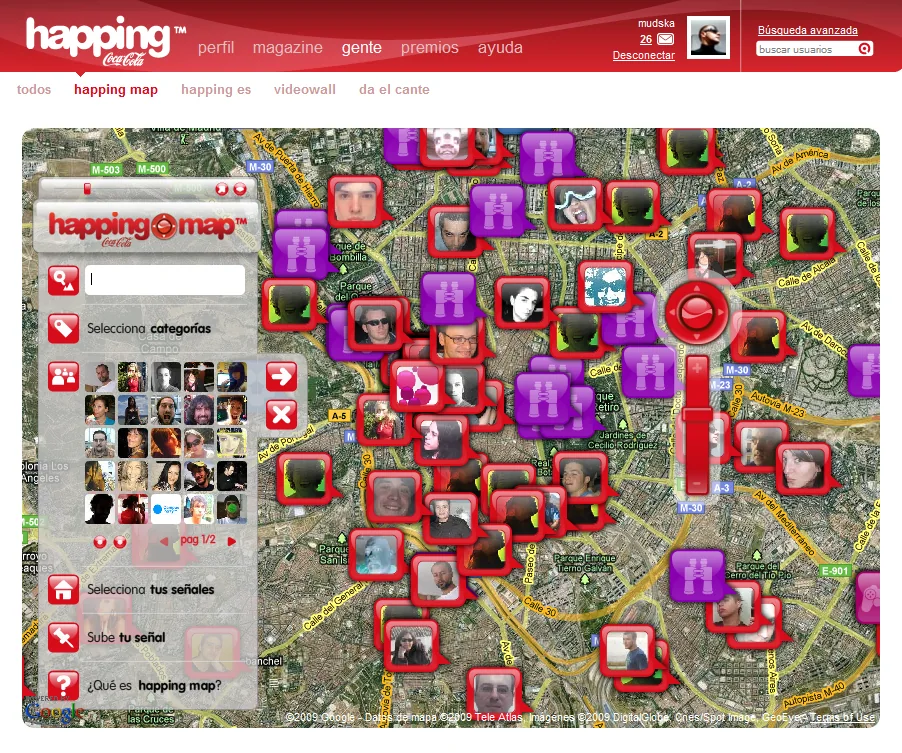
These materials do not establish audited user totals or business outcomes. They do show a specific approach to interaction: a brand provided a space, while people contributed places, stories and relationships. The map’s value depended on what they chose to share.
A question that still matters
Today we might call this geolocated experience, community building or human-centred design. In this project the idea took a direct form: marking a place because it meant something to someone. Technology provided the location; the person provided its meaning.
That relationship between infrastructure and experience continues to interest me. An interface alone cannot create a community. It can make sharing possible, help someone discover an affinity or give a conversation somewhere to begin. Happing Map was an early opportunity to explore those possibilities.
Sources and documents
WECOLAB: Coca-Cola Happing Map. Coca-Cola press release, “Coca-Cola lanza el Mapa de la Felicidad”, 24 July 2008; Happing Map manual, Campus Party 2008 presentation recording and a service screenshot dated 1 August 2009, preserved in my archive.